

Having a body feels hard sometimes.
Parents and caregivers know this truth intimately.
We are doting midwives and teachers, dementia caregivers and death doulas. This means that we are the first on the scene when it comes to the inescapable realities of embodied life: birth, illness, old age, death. We have chosen to turn toward these realities, instead of looking away. (This is why I love us.)
These embodied experiences can also feel complicated when we are reckoning with them inside of our own bodies, as well as outside of them.
I’ve written here about my own struggles in this regard: navigating endometriosis and infertility, surviving pregnancy loss and a pandemic-era postpartum period, healing from caregiver burnout, losing a beloved sibling to brain cancer, and caring for aging parents.
In this community, we also talk about the ways in which holding a marginalized identity as a caregiver can make it hard to be in a body. In my interview series, we’ve touched on what it’s like to be a woman in a society that polices our bodies in ways that don’t apply to men; a neurodivergent person (or the parent of one) in a society that doesn’t support our needs; a Black girl-dad and activist in a society that denies its racist roots; a trauma survivor in a capitalist society that doesn’t value healing; a queer and/or trans parent in a society that loves boxes and binaries; and a child of immigrants in a society that doesn’t speak their language
I’m sure those reading here can add on to this list, and I encourage you to do so in the comments if you can think of other reasons why it is hard to be in a body.
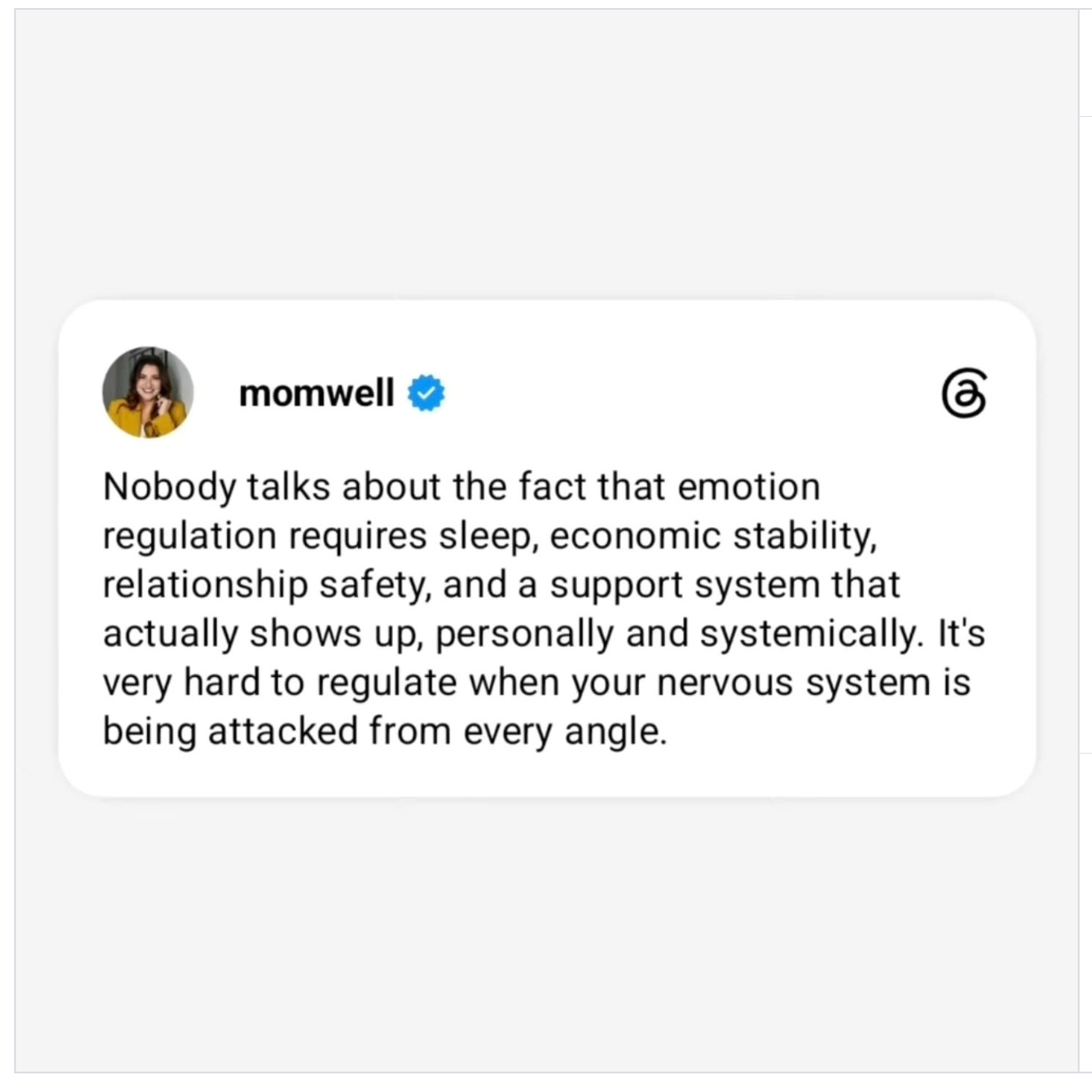
You know what makes all of this harder? Blaming ourselves for how difficult it is.
Blaming ourselves for the fact that we don’t weigh the same as we did in high school. For pushing ourselves too far and too fast, and then having to rest for days. For being so deeply impacted by things like bright lights, loud sounds, and the suffering of others that our nervous systems find it hard to receive that rest.
As Lodro Rinzler and I discussed here, blaming ourselves for our suffering, suffering that comes either from being a person in a body or being a marginalized person in a society that doesn’t support that body, is a painful form of “second-arrowing.” Meaning, it’s as though we are shot by one arrow (itishardtobeinabody) and then, instead of cleaning and dressing the wound, we stab ourselves again with a second arrow (anditsallmyfault).
What would the Buddha do?
As a longtime Buddhism practitioner and meditation teacher, I’ve been sitting for a few weeks with an early teaching of the Buddha’s called the Vitakka Santhana Sutra. While it doesn’t specifically touch on modern concerns like diet culture or anti-Blackness, it does speak to the more universal experience of working with very intense thoughts and sensations.
What makes it especially helpful to me, as a survivor of trauma as well as a trauma-informed practitioner, is that it offers choices, not One Right Way to do things. Five choices, in fact.
Conveniently, these five choices map onto the curriculum we’ve been slowly building for parents and caregivers here at In Tending. So, in this post, I’m inviting you along on the journey we’ve taken together this spring, and that I’ve taken myself alongside you on the cushion. Below, we’ll talk about five ways to work with the mind, if being in your body feels especially hard right now.
Tip #1: When you’re struggling with “thoughts connected with desire, hate and delusion,” the Buddha suggests that we “give attention to some other sign connected with what is wholesome.”
Translation: Give your mind something else to notice.
When I was growing up, my dad worked in landscaping. His advice, when it came to dealing with the kinds of pesky weeds that grow up between the stones in a path, was to simply grow something better in their place. Tired of tugging at knotweed, for example? Plant flowering phlox instead. That way, the weeds don’t have the chance to take root in the first place.
This is the essential wisdom at the heart of the Buddha’s advice. If you’re experiencing thoughts that you don’t care to be thinking–for example, noticing the same old critical narratives start to arise as you pass a mirror and notice something about your appearance that makes you feel vulnerable–you may be able to simply shift to noticing something else that is more beneficial to you.
What could you think about? Here, you have choices.
You could simply re-direct your attention to the breath. This takes practice, but over time, your brain will build this muscle, and it will come more easily.
If your mind remains talkative, you could give it a different script. For example, you could offer yourself some simple loving-kindness phrases: may I have safety, health, happiness and peace. You could also adapt these for your specific body’s situation. For example, I often offer this phrase in my classes: May my body be given care and compassion, just as it is.
Related resources:


Note: I’ll also be offering a free workshop on Mindfulness for Sensitive Humans on Sunday, May 30, as part of this weekend’s Self-Worthy Summit, featuring several brilliant Substack writers, mental health professionals, yoga teachers and more. You can register for free using my affiliate link by clicking this button:
Tip #2: If basic breath-based meditation or metta meditation don’t do the trick, you can stop to “Examine the danger in those thoughts.”
Translation: Notice how these thoughts lead to sensations, speech and action that tend to make it worse.
In my experience, when I allow my anxiety to run unchecked rather than working with it more intentionally, I’m more likely to get sucked into unproductive responses to that anxiety, such as avoidance, over-functioning, or indulging in addictions that make everything else harder.
As Pema Chodron points out in Becoming Bodhisattvas, there’s an additional opportunity cost to these kinds of distractions: they cause us to lose touch with the capacity to connect to others, and to see the other phenomena around us fully and clearly–which is the true gift of a precious human birth.
As researcher Jud Brewer MD PhD has similarly pointed out in Unwinding Anxiety, allowing ourselves to spiral takes the prefrontal cortext (PFC) offline. The PFC is like the captain of your brain. When the captain leaves the bridge, it becomes harder for you to direct your awareness, and more likely that you’ll crash into something, literally or figuratively.
I’ve been using Dr. Brewer’s book as a textbook in one of my in-person meditation groups, and my students are loving it. I’d love to get your thoughts on whether you’d find it helpful for me to develop a similar book club offering here at In Tending. (See poll below.)
In the meantime, my partner strongly recommends the Unwinding Anxiety app, which acts like a research-backed addiction coach and meditation teacher, for those moments at 3am when “just follow the breath!” sounds impossible to pull off.
Note: If you chose “I still have questions,” please feel free to put them in the comments below!
Tip #3: If noticing the “danger” in allowing thoughts to run unchecked doesn’t stop the flow of those thoughts, you can “try to forget those thoughts… just as a man with good eyes who did not want to see forms that had come within range of sight would either shut his eyes or look away.”
Translation: If breath or self-inquiry don’t do the trick, you still have choices—you can shift your awareness to something else.
Often in my classes, people will tell me that focusing on the breath, or attuning to certain parts of their bodies, increases their agitation. If you have asthma, then it makes sense that the breath may not feel like a safe or “neutral” place for you. Similarly, if you’ve recently lost a pregnancy or had major abdominal surgery, any mention of “the belly” may evoke similar feelings of pain or panic.
In cases like this, people feel stuck not only with their intense sensations, but also stuck with the belief that meditation does not work for them. Cue the second arrowing—which looks like either “Meditation sucks!” (an arrow directed outward at anyone who suggests it) or anditsallmyfault (directed inward, which can deepen the grooves of avoidance or addiction mentioned earlier).
For this set of folks, I offer this secret third thing: find another place to place your awareness besides the breath. You’ll know it’s the right one when it feels less like you’re being tossed in the ocean of intense body-mind-sensation-thoughts, and more like you’re able to sit, composed, on the shore.
Some options that have really supported folks my classes include:
Opening the eyes and shifting attention to the visual field. One option here is to simply allow the gaze to rest on a single neutral object, such as a tree or candle. If the mind feels too jumpy for this, you can slow things down by doing a quick color scan—noticing red, orange, yellow and so on in your visual field. This has the added benefit of bringing the prefrontal cortex back online, if you’ve recently been triggered, or are feeling disassociated. I find that after this, I’m more able to direct my focus with intention.
Shifting awareness to sounds in the environment. If your environment features more ambulance sirens than sound bowls, that’s fine. Sirens, espresso machines and leaf-blowers, as annoying as they are, can often be particularly useful objects for meditation, as they mirror the way intense thoughts appear in the mind: they arise out of seemingly nowhere, they peak in intensity, and eventually, without any effort on your part, they fall away.
Shifting awareness to the soles of the feet. Sometimes this will be contraindicated–if the feet are a site of pain, or if you cannot feel sensation in the feet. But in other cases, bringing awareness down to the feet can feel less activating and more grounding than tuning into the trunk of the body. Our soles can be exquisitely sensitive, and don’t require a lot of movement to give us feedback, so this can also be interesting enough that our minds are willing to become curious again, instead of contracted.
Walking very slowly, or lying down fully on the ground, while still directing awareness to where the body meets the ground. This can feel especially good if you’ve got a patch of grass or sand nearby.
These options are not so much practices on their own as ways to make all forms of practice accessible to all. If you’ve been on Team Meditation Sucks in the past, I invite you to try them and see if they shift something for you.

Tip #4: If bringing awareness to a physical anchor isn’t helping, you can try “giving attention to stilling the thought-formation of those thoughts.”
Translation: Tend the suffering, but drop the story.
My son is the kind of kid who will bounce off the pavement like a rubber ball after a fall, but who can be completely derailed by the wrong kind of jam on his PB&J. I’ve learned that when he’s having a sensory meltdown, more talking is not the answer.
Instead, I offer my lap. I bring awareness to his experience and mine. I breathe. As his body feels my enfolding presence, calm arrives, without me having to direct it. When I sense there is space, I help him make sense of what’s happening and bring closure to the experience by naming the feelings, offering empathy, and, if needed, suggesting something that might help—without getting stuck in the story of why the meltdown occurred in the first place.
This is the essence of practices like self-compassion meditation and RAIN meditation. We practice “stilling the thought-formation of those thoughts” not by repressing them, but by shifting the focus from thoughts of Who Is Bad And Who Is To Blame (the kind of thoughts that don’t serve us) to a place of calm and closure, through care.
Related resources:
You can learn more about these practices here:


Tip #5: Still finding it hard to work with the mind? The Buddha offers this startling advice: “Crush mind with mind.”
Translation: Bring in the capital-S Self to stand up to mental bullies.
When I think about this advice, I think about all of the stories my child and my students have told me about their struggles on the playground, or in the lunchroom, with difficult people who just will not leave them alone.
I imagine the Buddha here responding to his monks’ concerns about their difficult thoughts like an exasperated 80s dad: “Well, if he’s hitting you, then you hit him right back!” As a prince raised in a culture of warriors, it’s understandable that this might have been his go-to.
As for me? I think we’ve got more options now than we did 2,500 years ago for working with bullies.
In particular, I think back to an 8th-grade English class I taught in the Bronx, and a particularly tough teen we’ll call Jaylon. Jaylon had a lot going for him: college-level reading comprehension abilities, a great sense of humor, and an admirable sense of self-confidence for someone with such a patchy mustache. The other kids looked up to him; girls wanted to impress him, boys wanted to be him. One day, I heard Jaylon grumbling audibly in the back of the classroom about the level of work I was asking them to do, and about me in particular.
“He’s insulting your class!” one kid called out. The other kids’ heads swiveled around to see what I would do.
I just smiled. “Jaylon’s allowed to have whatever thoughts he wants about my class,” I said. “And I want to remind all of us that I’m an adult, not a kid, so Jaylon having a thought or saying a thing isn’t going to hurt me.”
The kids were stunned silent. It hadn’t occurred to them that I was not part of the same social hierarchy as Jaylon, that I too would not cower in the presence of his patchy mustache.
Immediately, the temperature in the classroom seemed to drop to a more comfortable level. Kids’ heads went back down to their work. Best of all, Jaylon gave me a big smile from the back of the room. He too felt better, knowing that his big feelings were safe with me—that they couldn’t hurt me.
A few days later, he asked if he could eat his lunch with me instead of the kids in the cafeteria. He needed the break, he said, from all of their drama.
Did I “crush” Jaylon? I don’t think I did. Did I “crush mind with mind”? I think this is the essence of the teaching.
If you haven’t spent much time mediating conflicts between inner or outer bullies, you might try the following:
Explore Internal Family Systems theory. This new take on an old idea—that we contain multitudes—invites us to cultivate the ability to broker peace between our inner “parts.” To get to know our inner wise adults, our testy inner teens, our meek followers of the mind—and to create a space where all feel safe and held, with a very firm hand. (Therapist Jeremy Mohler helpfully shows us how to do this here.)
Re-visit the story of the Buddha’s original enlightenment and his battles with Mara, the ultimate playground bully. I discussed this recently with Lodro Rinzler and Kate Lynch. Both offered the perspective that connecting with Mother Nature as the ultimate wise adult and benefactor can bolster us when we’re not feeling so strong on our own.
To me, it makes all the sense in the world that Mother Nature would know intuitively what to do with every sensation, every hard thought, every arrow twanging our way. She’s already seen it all. She has known birth and loss, aging and illness, clouded awareness and clear blue sky.
And really, at the end of the day, that’s all mediation is, to me. It’s a time and a place to touch in with this larger of strength and resolve that is always available to us, right here, underneath our feet. And I think any way that takes us back to this place of deep wisdom, to what the sages called yoniso—the womb, the source, the root of awareness—is a good way to go.


Amazing!! Reading this just made it click for me when I lay on the sand, I easily fall into what I think is mediation! Love the story of Jaylon too!
I love these concrete strategies!