
Practice: Working with burnout, in ourselves and in the world
Small acts of rebalancing can make big ripples, because we are all connected.

I am a cell-sized unit of the human organism, and I have to use my life to leverage a shift in the system by how I am, as much as with the things I do. — adrienne marie brown
When I first began to work with burnout in my meditation practice, after leaving my last classroom teaching job, it was not a calming experience.
Initially, I felt deeply ashamed.
What is wrong with me? I’ve been meditating for years. Why am I so stressed?
Why do I keep letting this happen to me?
Why don’t I love this role the way that I used to?
And why is it so hard to figure out what to do next?
Fortunately, my mindfulness practice has been helpful in softening the anger, confusion and self-blame I’ve felt around being–well, not mindful enough to be immune to burnout, apparently. My practice has also helped me to bring more compassion to everyone who now comes to me with the same forms of suffering I was experiencing, back then.
Below, I offer a sense of my own bread crumb trail when it comes to working with burnout in my meditation. May the words and audio meditation that follow be of benefit to you if you are looking for one small way to put out the fires of burnout inside of your own life today, and to build a better world for us all out of the ashes.
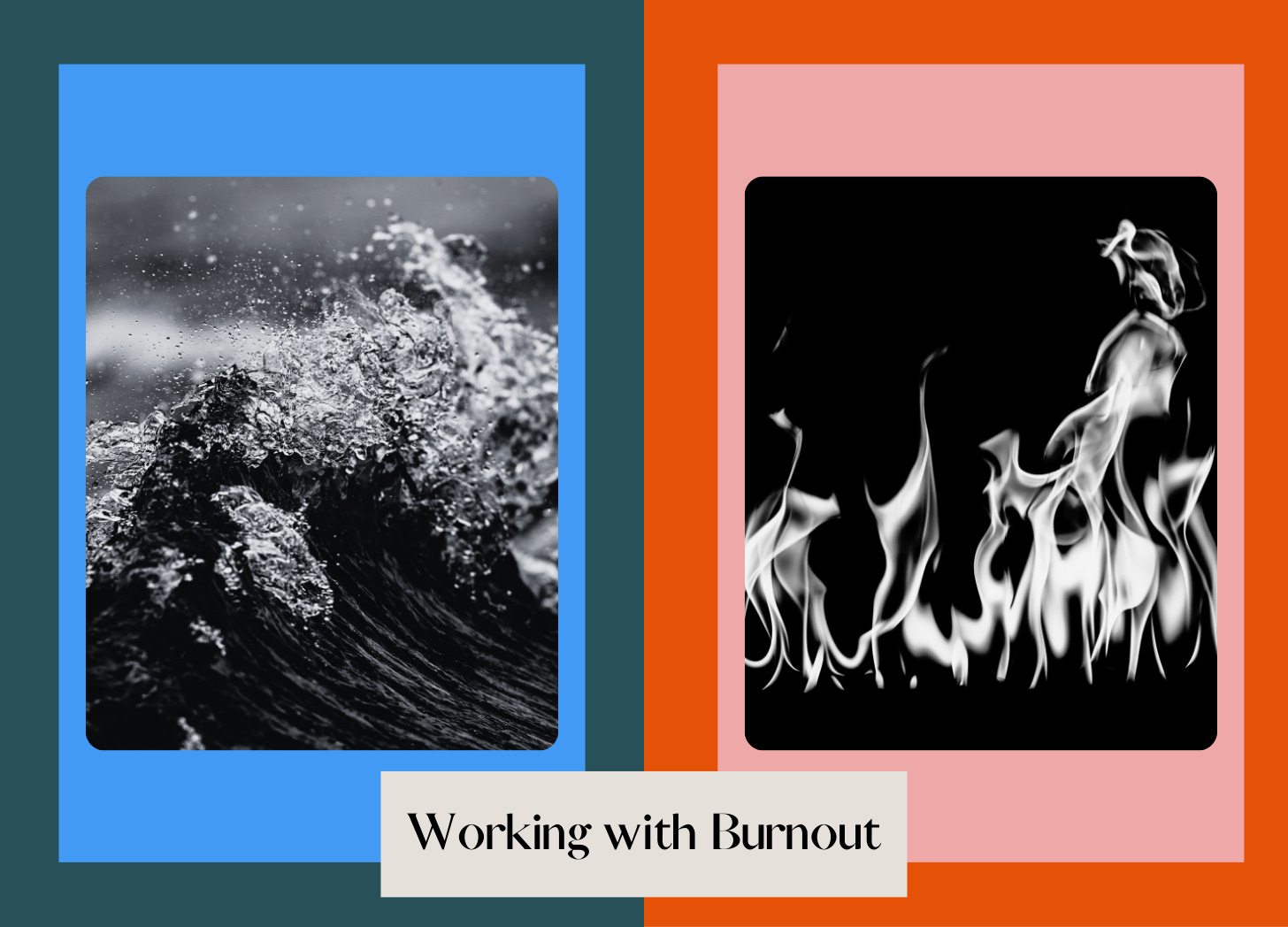
What is burnout, exactly?
Burnout is a common topic in the caregiver world, but we rarely take the time to define it. Is it a disease, a personal failing, an inevitable consequence of living amidst the multi-crisis?
When I left the classroom, my inquiry began there.
Emily Nagoski and Amelia Nagoski, in their excellent book on the subject, describe burnout as a state of being with three common components:
A dip in energy
A decreased sense of empathy and compassion
A nosediving sense of self-efficacy and accomplishment
When I first read this definition, I thought: check, check and check.
Since starting this newsletter and community, I have also heard burnout described in the following ways by readers and caregiver circle participants:
A sense of feeling fuzzy and disconnected from ones’ immediate surroundings, and even ones’ own body. I hear often from folks that during seasons of burnout, they have spent days or weeks in a state of dissociation–a sense of going through the motions, without feeling emotionally or physically connected to what they’re doing.
A sense of feeling trapped, stuck or without choice. Maybe you’re moving through a season of cluster feeding with a newborn who depends on your body for food. Maybe you’re stuck co-parenting with an ex who has a mental illness or a penchant for being late with the child support payments. Maybe you’re struggling to face the realities of caring for an aging parent because your other family members refuse to do so. There are so many reasons why caregivers might feel this way. And it seems to be extra acute in the wintertime, as we can’t get outside as easily for a brisk walk or a literal breath of fresh air.
A sense of being either under-reactive or over-reactive in proportion to what’s happening. For some of us, burnout feels like having a constantly depleted battery. We can’t get going. We can’t get excited. Nothing feels fun. For others, burnout looks more like constant irritability and reactivity–snapping at others, getting disproportionately upset by small things. Often, this leads to additional waves of suffering, as guilt and shame arise in the wake of our latest outburst.
A waning faith in a “light at the end of the tunnel.: If things aren’t getting better despite our best efforts, and our usual coping mechanisms either aren’t working or aren’t accessible, it can feel as though there’s no way out of burnout.
Why we can’t heal from burnout alone
Burnout is both a moment-to-moment experience that can be felt in the physical body, and it is a systemic issue. One created by an especially extractive economic system that is depleting the environment, inside and outside of us. So, while we might shift our individual approach to reality in order to decrease our individual levels of stress, we can’t shift the larger reality alone. Believing that we can or should, in my experience, just adds to the suffering.
Experts have told us time and again that battling bigger issues of planetary burnout, such as climate change, is not going to be solved by one silver technological bullet, but a million tiny organic solutions, rooted in acts of care.
Similarly, in my experience, working with individual burnout is not a one-and-done deal, solvable by one big splashy Bali retreat, but many small, repeatable acts of self-compassion that we can return to again and again, in our everyday lives.
The practice that I have cultivated over time to rebalance myself amid burnout is one such small act–one that reminds me, time and again, that small acts of rebalancing can still make big ripples, because we are all connected.
As adrienne marie brown writes in Emergent Strategy:
What we practice at the small scale sets the patterns for the whole system. Grace Lee Boggs articulated it in what might be the most-used quote of my life: “Transform yourself to transform the world.” This doesn’t mean to get lost in the self, but rather to see our own lives and work and relationships as a front line, a first place we can practice justice, liberation, and alignment with each other and the Planet.
So, where do we begin?
Building on brown’s thinking, I would invite us to “start close in,” as David Whyte says—inside of our own bodies and hearts. Below, I offer a mediation that makes connections between what’s “in here” and what’s “out there” that has benefited me during seasons of burnout, and that I offered to our caregiver circle recently.
A bit of background
The meditation I offer here takes its inspiration from four physical elements–earth, water, fire, and air–that are invoked in the Pali Canon, the earliest collection of the Buddha’s teachings.
When the Buddha discussed these four elements, he pointed out that they exist both inside and outside of our bodies. This insight has since been confirmed by scientific research, and may seem like common sense. The Buddha stressed, however, that those who seek truth should also seek to verify these things for themselves, through direct experience, i.e. through sitting meditation. He never wanted people to simply take someone else’s word for it.
So, when we meditate with the elements, we are often invited to directly experience them. We can feel the solidity of our bones, as we take our posture and feel them holding us up, and holding us together. We can feel the breath and the pulse, as water and air molecules from “out there” enter our lungs and our blood. And so on.
I consider this meditation helpful for burnout for a few reasons:
Connecting with the earth element can help us re-ground ourselves in our bodies if we’re feeling numbed-out or dissociated.
Connecting with the water element can remind us of the fluid, ever-changing nature of reality that lies beneath the frozen surface of seeming stuckness.
Meditation can also ease our bodies into the “rest and digest” state that is so crucial for breaking down our food for energy, much as a fire does when it breaks down wood for fuel.
Connecting with the air element can support us in touching the spaciousness that lies both inside and outside of us, as we allow our exhales to grow longer than our inhales.
Meditating in this way, we can also come to experience three important truths–known as the three marks of existence–that underpin the Buddha’s teachings.
Anattā: The distinctions we tend to make about what’s “in here” (me, myself and I) and what’s “out there” are not as real as we tend to think they are.
Aniccā: Change is a constant, both “in here” and “out there.”
Dukkhā: As a result of the above, we’re never going to be able to maintain ourselves in perfect comfort, all the time.
These three principles can, in turn, help us to gain a better understanding of how burnout occurs.
The principle of anattā explains why the extractive forces that are exploiting and polluting the stuff “out there” are making us feel depleted “in here”—because “in here” and “out there” are the same thing.
The principle of aniccā explains why even if we do sometimes manage to make things a little better in our individual spheres, they don’t stay that way—because change is a constant. Larger spheres of instability around the world will inevitably create instability in the microcosm of our lives and bodies.
The principle of dukkhā explains why we may find ourselves physically depleted, mentally frustrated, and emotionally closed-off if we are trapped in a situation in which superhuman perfection is expected of us, but imperfection is inevitable. (This more or less describes what it was like for me to be a classroom teacher, and what it often feels like to be a mother in America.)
If we understand how burnout occurs, we have a better chance of preventing the aspects of it around which we have some choice.
Acknowledging the principle of anattā, I have come to understand that I am one small part of this living, breathing world. Not separate from her, or her fate. I know in my bones that I cannot carry the weight of the world’s suffering by myself, and I no longer believe that I have to.
Acknowledging the principle of aniccā, I remind myself constantly to train in cultivating equanimity as things change, rather than over-reacting to each small shift in plans. I think often of the Zen parable of the wise farmer (yes, the one from this Bluey episode), who said, in response to seemingly good or bad luck, “We’ll see.”
Acknowledging the principle of dukkhā, I no longer view it as my job to smooth over moments of mild discomfort for other adults. I no longer take responsibility for doing other people’s deeper work for them. I do, however, find it worthwhile to spend my time divesting from and calling out the human greed, aggression and delusion that are disrupting the web of life for all sentient beings. I find it particularly meaningful and empowering to invite others into this work with me, as I am doing here.
In this recording, I invite you to give it a go:
And please, feel free to drop your comments, questions, concerns, or complaints about this audio recording in the comments!
Paid subscribers, you can find the script for this meditation below, as well as a curated playlist, with tracks curated to support you with burnout recovery and resistance in 2026.
Further reading:
I really appreciated reading this take from Kaira Jewel Lingo on what this practice can look like for an experienced meditator, and how we might experience space and consciousness alongside the four above. (All six elements are mentioned together in Buddhist texts such as the Dhāthu sutta but I find those less-tangible two are harder to access if you’re new to the practice.)
For more on the ways in which we can meet planetary burnout with care and optimism, please see this beautiful conversation between climate and parenting journalist Anya Kamenetz and care expert Lisa Sibbett.
For more interviews and perspectives on burnout, on both an individual and systemic level, be sure to check out the following here at In Tending:
Our conversation on burnout and gender socialization with The Gamer Educator/Ash Brandin here
Our discussion about burnout and neurodivergence with ADHD coach Kelly Banks here
Our exchange about burnout and right livelihood with anti-capitalist business coach Emily Eley here.
