


Deciding whether or not a particular label suits us is is an important act of declaring. It invites us into a deeper relationship into the interior of ourselves — the way we experience the world, the way we respond to it. It also provides a new map of the landscape of our lives — possible reasons why we struggled here, and didn’t there. It provides a compassionate lens for revision on the story of our lives.
This is true for those of us who notice a heightened sensitivity to their inner feelings and outer environments — what some researchers call “orchids.”
For us orchids, mindfulness can be a huge boon — our meditation cushions are places where we can finally reduce the stimuli around us in order to hear ourselves think. Literally.
If you are just beginning to investigate the notion of sensory processing sensitivity for yourself, or the implications of mindfulness as part of a sensitive-system self-care routine, you’re in the right place.
In this interview with my fellow sensitive human Kate Lynch, we talk about three common areas of struggle for sensitive people, and how she’s learned to bring healing awareness to each one.
In this discussion, we also talk about:
Self-Worthy, Kate’s upcoming free online summit for sensitive humans on May 28-30, where I’ll be appearing on Day 3 (00:02:03)
The benefits of mindfulness for sensitive humans—beyond just “feeling calm” (00:09:18):
How mindfulness helps sensitive folks show up in a boundaried, authentic and consistent way in our communities (00:14:03)
How to work with a loud inner critic (common for sensitive humans!) on the cushion (00:21:01)
Why sensitive people need what Kate calls “saturation time” after deep inner work (00:33:47)
The mindfulness books that have given us pause recently—in a good way (00:36:04)
Read on for some transcribed highlights from our conversation!
On Self-Worthy, Kate’s summit for sensitive humans
(00:02:03) Ryan: So you’re busy organizing things for all of us highly sensitive people, so that we can feel a little bit more comfy—even though we’re talking about not being very comfy today.
I’m actually really curious to hear what you’ve been learning from other people that you’ve been interviewing and in conversation with lately. You’ve been talking to all kinds of mental health professionals—and I’m so lucky to get to be among them—and learning from this team of people, this Ocean’s Eleven group of people that you pulled together for the Self-Worthy Summit. What have you been learning? What are some things like that you would be interested in sharing from those conversations? Because I haven’t had the opportunity in my recent travels to catch up with all of them.
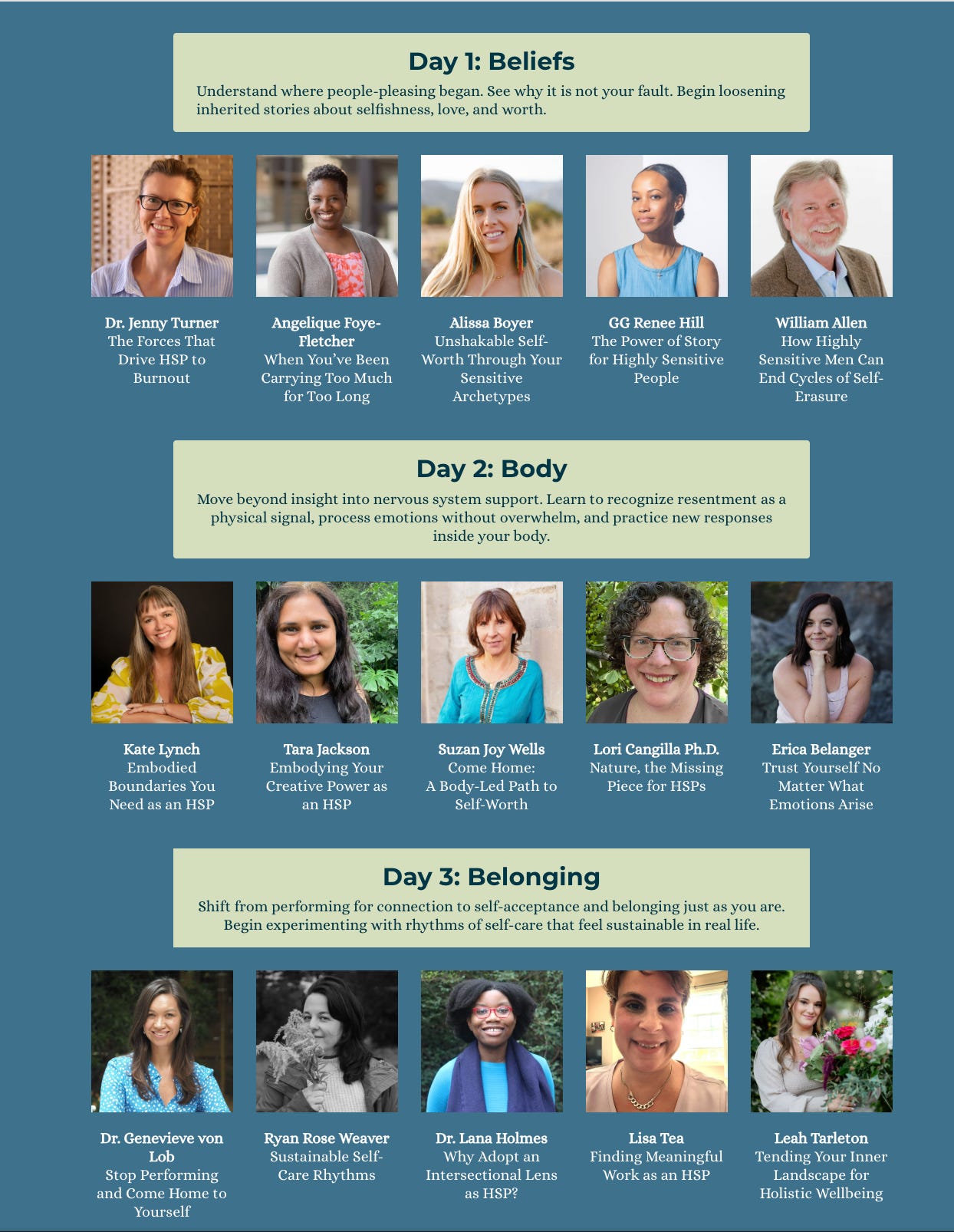
Kate: I mean, where do I even start? The incredible thing is how they intersect, like a a weaving. One touches on something that the other one goes deeper into. One of the speakers called it a symphony and I was like, “Yes!”
Ryan: Yes! It really feels that way! That’s how it feels! We all have a role to play!
Kate: They’re like three stanzas!
Ryan: Yeah! And do you find that they’re kind of organizing along the three themes that you have?
Kate: Yeah! … So some people in Day One (Beliefs) are really talking about their experience of learning about high sensitivity, and how they felt suddenly like everything fell into place.
Some people are talking about the cultural conditioning, from different angles and different perspectives, that impacts us, and impacts us more as highly sensitive people.
Some are breaking it down a little more, into being a highly sensitive person who is also a caretaker, or a people pleaser who tends to abandon their own needs, or even forget that they have needs.
So it’s tight, but it’s broad in a way. It goes deep, but they’re very aligned with each other. And I think if you chose any of those five [Day One speakers]… you would get a picture of of what it is like to step into the belief that it’s not our fault. Being highly sensitive is a trait that’s innate. And then culture has dumped on us all these expectations that make it really hard to accept ourselves.So that even starts the transformation of being able to accept ourselves a little more, right?
And then on Day Two (Body), we drop into the body. I love the way embodiment shows up from in different perspectives, from different speakers… Day Two is about bringing it into your nervous system. Through creativity, through forest therapy—which is lovely. And then we have a couple yoga teachers doing very simple things to connect and come home to your body and your emotional wealth.
Finally, on Day Three (Belonging), continuing that to: “How do I take this with me and carry it forward?” So much of that is about belonging. So much of that is, “How do I maintain the sense of belonging that I discovered in this summit and bring it with me?”
I loved the way you infused mindfulness and sensitivity on Day Three. It bridges that gap between practice—which we really delve into in Day Two—and going forward with belonging. Because mindfulness can be such an amazing tool. If we feel like we “don’t have time,” there’s always something we can do.
So, I’d love to ask you a question about that.
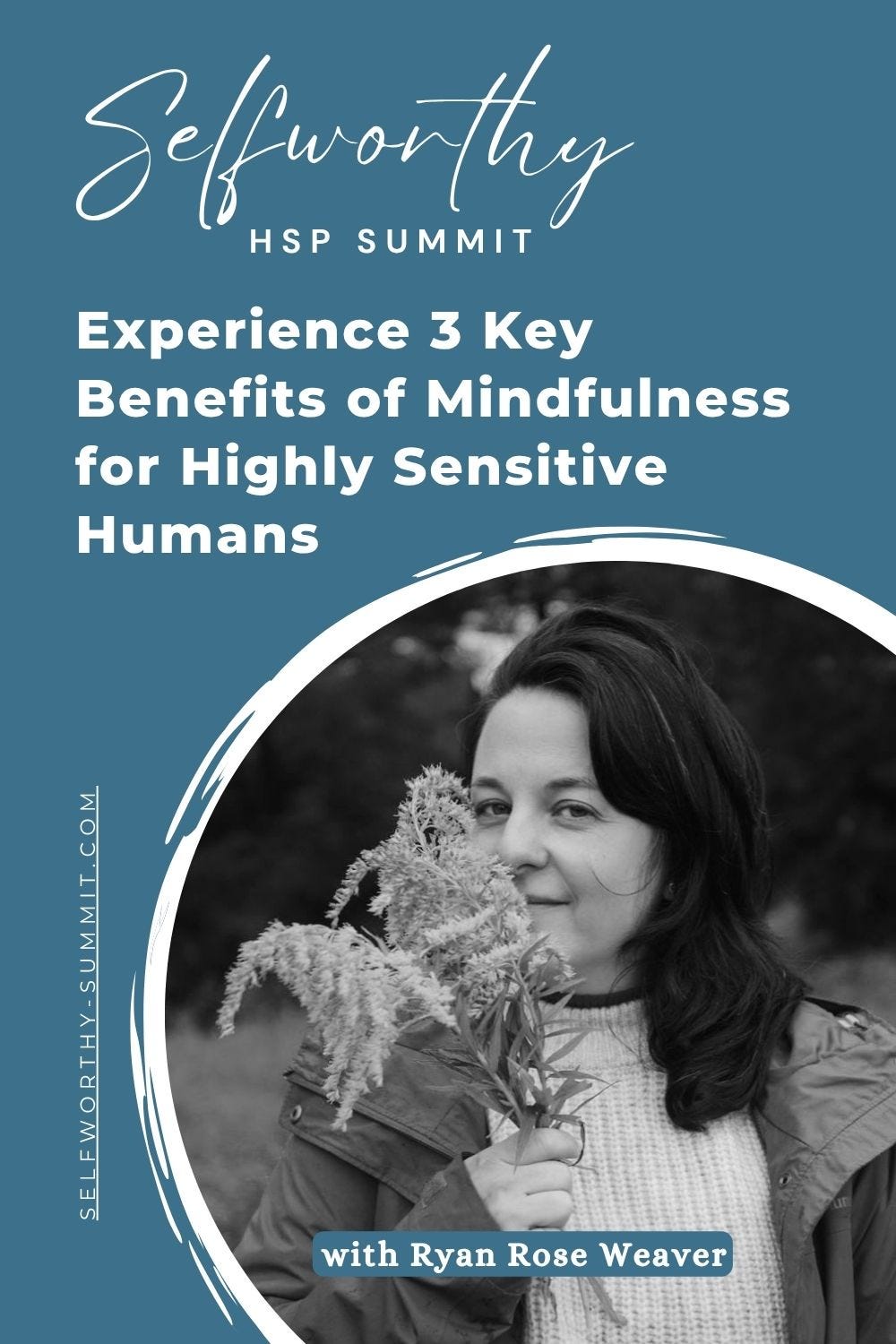
Beyond calm: the benefits of mindfulness for sensitive humans
(00:09:18)
Kate: What inspired you to teach the practices that you did [for the upcoming Self-Worthy Summit], and to go a little deeper into the roots of mindfulness?
Ryan: I think that it’s important to talk about this intersection of mindfulness and high sensitivity because we know that people who are extra sensitive, we can benefit so much from all kinds of interventions. Research has shown that people who are highly sensitive are more negatively impacted in environments that are challenging, and they’re also more able to rebound and be resilient, and to really be healed, by good interventions.
I have found that to be true of myself, in that I think that mindfulness has had potentially a disproportionate positive impact for me as a sensitive person, as I’ve practiced it. Other people might not experience those benefits.
But, it is also challenging, for reasons that I talk about, in the small talk that I’ve given for your summit.
For example, a deeply internalized, loud inner critic, that comes from our socialization, is one of those things that we might meet as highly sensitive people.
The other piece is just that our body sensations that we’re supposed to be tracking through traditional methods, like body scans, or noticing the breath—they can be really loud. And for those of us that also struggle with chronic pain, that’s not necessarily always going to be a calming experience.
And so mindfulness has been a really positive experience for me, and I’ve also had to really persevere through a lot of challenges.
I think that what has really helped me, and what I want to offer, is knowing that what mindfulness offers is so much more than just an experience of calm.
I think calm is wonderful, and I think that it’s a very effective marketing strategy for mindfulness and mindfulness adjacent offerings. But I think promises of calm really mislead people—and particularly highly sensitive people—to think that if they don’t feel calm when they’re exploring mindfulness for the first time, that there’s something wrong with them.
We’ve already gotten messages all throughout our lives that there’s something wrong with us, if we’re engaging with this thing that’s designed for the general population and it doesn’t feel good to us.
Kate: We’re not “doing it right!”
Ryan: Yes. Whereas actually, we need more tailored guidance. We need guidance that’s very aware of nervous system diversity, and that makes space for that.
So I think that your [Self-Worthy Summit] framework is really powerful, because what I’ve experienced, and what I’ve articulated in my space, is that the point—and I know that with mindfulness, we may also question whether there should be a point, but let’s just say, the thing that has motivated me to stick with mindfulness—is not: You’re going to feel calm. I think that’s not responsible advertising. My “sales pitch” is: You’re going to experience some inner clarity.
I think that what you’ve described, in terms of really understanding yourself better as a sensitive person, understanding how your nervous system works, understanding that this is a trait, that this is not a flaw—I think that that comes as part of cultivating inner clarity.
I think getting to know yourself better is more important than feeling “calm,” and being “nice,” and being pleasant, and whatever anybody else wants you to be. I think getting to know yourself fully is more important than squishing yourself into yet another box.
And so I will say mindfulness is something that has allowed me to just get to know myself, and get to know the experience of having an inner critic arise, and tell me “I’m doing it wrong,” or having a real pain arise in my body, and learning how to work with that in ways that are kind and trauma-informed, rather than forcing myself to push through—which is a very common sensitive person experience.
How mindfulness helps sensitive folks show up in community
(00:14:03)
Ryan: I would say that the other piece is that [mindfulness] helps us to show up in community. To really stand in our truth and to say, “This is how my nervous system works. This is what I need. This is how I am. This is how I can best contribute.”
Mindfulness allows us to show up to community differently, and to soften some of those patterns that you talked about. To soften patterns of people pleasing, of just trying to be whatever anybody needs us to be, and instead saying “This is what I need in order to show up as my best self—and that may not be what you need from me. But that’s how I’m choosing to show up.” I think mindfulness allows us to establish that base within ourselves, and then move forward from there.
And I think it helps too, with the piece that you mentioned, about being a caretaker in some way. Which I think of as a subset of people pleasers. Like, I don’t necessarily feel as though I need to be pleasing in every context, but we if we don’t have a plan for dinner, then please trust and believe I am stepping in, and probably over-functioning, to make sure that the people in my family get fed. I think that that is a form of people pleasing, but it’s also just about my people, and about pleasing myself.
I think that being very, very attuned to a family environment—or work environment, if you’re a helping professional, which so many of us sensitive people find ourselves becoming—there can be such attunement to what the environment needs from us that we can lose touch with our inner sensations, with our needs. I think that over time, this erodes our ability to show up in a regulated way.
And so what I end up noticing about myself, and what I’ve read in the literature about highly sensitive people, is that we sort of oscillate. We can be these almost psychically attuned, compassionate, empathic, present, nourishing humans to be around. And then, when we get depleted, because we’re so attuned to the other person that we’ve lost touch with I’m hungry, I’m thirsty, I need to go to the bathroom, then all of a sudden, there’s a switch that flips, and all of a sudden, we’re dysregulated. We’re having a sensory meltdown. We are more irritable.
Kate. There’s rage, even. Burnout.
Ryan: Yes! Rage can be a part of it. Especially for those of us that are sensitive and also may have an additional element of neurodivergence, right? If you have ADHD, if you are on the autism spectrum, those can also be a really confusing part of the caregiving experience. Like, “I love these people so much—so why am I suddenly in a murderous rage?”
When something doesn’t feel right, a lot of times, it’s because we’ve just lost touch with that interoceptive awareness of our own needs. We’re well-intentioned, but we’re not necessarily well-regulated. We’re not necessarily claiming the right to take care of ourselves.
And I’ve experienced that in myself—that sort of Dr. Jekyll and Mr. Hyde shift. It’s eroded trust with the people for whom I care. And I don’t like that.
So truly—and I wrote a note about this the other day—the thing that keeps me on my cushion, and that keeps me accountable for my mindfulness practice, is not anything fancy. It’s not even necessarily aspirational. It’s just preventative care for my relationships. It’s helping me be more consistent, and less of a jerk to the people that I love the most.
And unfortunately that means being less of a jerk to myself—and you have articulated what a puzzle that is. How hard it is sometimes to hear, “Put on your oxygen mask first!” It’s really hard to figure out exactly where to start, in this reciprocal sort of call-and-response that we have, with our loved ones and our own needs. But I think that mindfulness offers a space for this.
The way that I describe it is being like a sit spot. I just was at the beach, and there, it’s just about getting out of the water, and toweling yourself off, and finding a place to sit and just watch for a little bit. To see: What’s happening? What’s true? Without there being a should. As in: “You should take better care of yourself. You should be more attuned.”
It’s just coming back and seeing “Well, those are some shoulds that exist—but what is actually happening? And can I just be with that?” And from that place, can I make a choice, that isn’t just my normal habitual reaction that I take?
I think that’s so powerful for highly sensitive people. Because we certainly don’t get that education from our culture. We aren’t taught how to take a break, to bring awareness to the situation, to reassess with self-compassion instead of criticism and should-ing, and then assessing where our energy needs to be.


Does all of that lead to calm? Sometimes. Does that lead to me sometimes saying, “What I need is to go in my bedroom and lock the door, and all y’all need to figure it out for the next couple of hours”? Sometimes that is where it leads.
So I would just really encourage us to release calm as the reason, or the end goal, or what we’re “supposed to be” experiencing. Because I think that the reality is much richer, and it’s more respectful of our interior landscapes when [our mindfulness practice] lets them be wild, and lets the tide be wherever it is, and it lets there be storms, and it lets there be tranquil days. When it just respects that we’re part of the landscapes that we inhabit, and we are multifaceted.
So that’s also just something that I talk about in the meditation. It’s just inviting people to come back to that connection. As you said, that connection with the earth feels really, really important. And it feels like where belonging lives for me. It’s just saying, “If the earth can have her seasons, why can’t I have my seasons? If the earth can have storms, why can’t I have storms? f the earth has seasons of rest and fallowness, why do I always have to be going? That doesn’t seem right.”


How to work with a loud inner critic on the cushion
(00:21:01)
Ryan: Last time we chatted, you gave me really good advice on self-compassion—and I have another FAQ on this that I get. I’m really curious to hear from you as an experienced teacher.
What do you do when you are bringing awareness to your patterns, and it’s hard to call in compassion for yourself? Like, if your inner critic is incredibly loud, and even as you’re finding your sit spot and seeing the sort of habit loops that you move through—how you get hooked, how you forget your body or your needs—it sounds like, “Here I am again, melting down. I didn’t take my break soon enough!”
I ask because I notice that as you’re learning about yourself as a highly sensitive person, I notice in some of the people that are doing this work that there’s a lot of clarity, and there’s not a lot of compassion.
Within mindfulness, we talk about clarity and compassion needing to be like two wings of a bird. Sometimes it feels like the clarity wing starts developing, and it’s like this huge muscle, and then the compassion wing is tiny. It’s not quite keeping up. And so I find that it’s a stumbling block. It’s hard for people to really take flight and find that sense of belonging, if they don’t have a lot of experience with giving themselves compassion for the things they notice. Like, “Yes, you do struggle when you don’t take a break—and, sometimes you won’t know when it’s time to take a break until it’s too late.”
How do you talk to yourself then, instead of saying, “Well, I’m just back on my bullshit, and I’m just irredeemable as a person?” And, how do you support other people with a loud inner critic, as they’re learning new patterns, to not be so hard on themselves, if that re-parenting and re-learning is hard?
Kate: The two wings of awareness—that is one of my favorite things about mindfulness. Awareness is not just clarity. Awareness is not just I know these things. I unpacked all this in therapy. I know my parents abandoned me. I know that I developed this coping mechanism of people pleasing from a place of survival and developmental trauma. Or whatever.
That’s the start. That’s Day One.
Day Two is grounding in your nervous system. It’s not about being calm. It’s about being regulated. And so much of that is, Let me give myself a hug right now. I am not alone—I’m one of one drop in an ocean of awareness. I am not alone—even in this particular feeling thought trait or need. I’m not alone—lots of other people have a really mean inner critic.
It’s also about, like, the most basic self-compassion stuff. Like, “What would your best friend say to you?” Or, “What would I say to my best friend? If they were vocalizing this inner critic, if they were actually saying these words to themselves—what would I say to them?” Or, “What would I say to my child? How could I be so cruel to someone I love?” And it takes practice.
And, maybe, rage. Resentment. A strong awareness. An unpacking. Realizing that, “Oh. This is generational. This is cultural. This isn’t just me. There is pain involved, and I can be upset about it.”


Dr. Jenny Turner—you’ve got to listen to her talk. She’s a feminist. She speaks from this place of really spelling out that dynamic. How it’s the systems, many systems, that have created this, and we can be cycle breakers. How it’s hard, how there’s pain there, and I know I’m not gonna be calm. We can can get mad about it first.
But just remembering we’re not alone, I think, is the most essential part.
And when it comes to compassion, sometimes we have to just think about a little tiny baby—whether we’re thinking about compassion for others or for ourselves. Like, we’re not gonna be mean to a baby, right?
Like this puppy [in the background in Kate’s house]. The puppy’s barking, he’s being a pain in the ass, but I’m not criticizing him.
Ryan: He’s a baby, and he’s doing what babies do.
Kate: And that’s where we learned it. We learned it when we were babies. So this harshness, it’s understandable—and it really could take a step back.
That kindness balances out the clarity, like you said. It balances out the Oh my god, I’ve suddenly been awakened to all of this stuff that makes me really agitated. I can also be kind to myself. I can breathe. I can take it slow. I can take breaks.
This is why I think the nervous system regulation part of Day Two is so important in the summit. Because if we’re dysregulated, and we’re still not letting ourselves rest—like, say we go straight from people pleasing to being angry at the systems that are keeping us small—that’s a lot to take in for our nervous systems. If we go right into learning, learning, learning, and we don’t give ourselves a break of breathing and being, it’s actually harder to learn.
We need the rest to our nervous systems. We need the rest in order to embody and absorb and assimilate all that we’re taking in. So that pause, that spaciousness, literally letting it all simmer, is the best thing we can do after having all that clarity kind of awaken for us.
I don’t know about you, but if I’m reading something really awakening, really opening my eyes, I sometimes just fall asleep. Or if I’m listening to something that’s very heady, I’ll just doze off. And yes, I’m tired. You know my life is too full. But also, I need that in order to assimilate it—in order to let it become part of me. If I go straight from learning it to teaching it, or from learning it to trying to apply it in my life, it’s inauthentic. But not if I rest back and allow it to kind of wash through me.


Why sensitive people need “saturation time”
(00:33:47)
Kate: You know the RAIN protocol, right? I added an S. For satiate. Just letting it absorb. If you’re standing in the rain, just allowing it.
Ryan: Saturating, too.
Kate: Saturate! That’s the word. That’s what I added.
Ryan: I mean, I love the word satiate too.
Kate: Simmer, saturate…
Ryan: Soak it in… Man, all of these are so good.
So just saying back to you what I’m hearing from a mindfulness perspective, it sounds like, if we’re experiencing self-blame—Why am I not better? Why am I not fixing myself faster? Why am I still doing this?—it’s first Recognizing: Oh, this is self-criticism.
Acknowledging or allowing: Oh, my inner critic is here. These critical thoughts are here.
Investigating: When my inner critic is here, these are the embodied cues that let me know that I’m sort of getting possessed, instead of being my best self. I’m feeling some sort of tightness.
Then, Nurturing, like you said. Bringing in self-compassion. Wait, other people feel this too. Wait, this is structural. This is not my fault.
And then: Soothing and Saturating. Whoa, this whole thing is a new understanding for me, a new way of relating to that inner critic.
This, rather than cringing and doing whatever it tells us to do, and believing that it’s real, or even believing that other people think this about us, and treating them accordingly.
What you’re describing is profound. Profound cycle-breaking and unlearning.
And like you said, yes to mindfulness, but also like, yes to a good nap after that.
The mindfulness books that have given us pause—in a good way
(00:36:04)
Ryan: I have definitely experienced this recently in engaging with some new cycle-breaking material.
I’ve been reading Unwinding Anxiety by Jud Brewer MD PhD, where he talks about bringing awareness to habit loops.
I’ve been reading the book Are You Mad At Me? by Meg Josephson, that’s about people pleasing—and she brings in a lot of mindfulness.
And with both of those, I’m like, “Yes! I have needed to nap so much more, as I allow this to saturate my being.”
Kate: Have you read Sebene Selassie’s book You Belong?
Ryan: I haven’t, though I really admire her work.
Kate: I would add that to your TBR [to be read pile].
Ryan: I’m always looking for a TBR. Let’s put it in the footnotes.
What if there was nothing wrong with you?
(00:37:31)
Kate: And [after the pause], we need that moment of saying, “What would it be like if there’s nothing wrong with me? What does that feel like in my nervous system?”
Ryan: I think my inner critic has a lot of clap-backs to that.
Kate: It’s hard.
It also brings up the question of compassion towards those who we dislike or we think are actively harming this world, or us.
How do you have compassion?
Ryan: Interestingly, I interviewed Lodro Rinzler recently, who just wrote a book about basic goodness, and he talks about that. About what it’s like to extend this notion that we’re all good inside, that we’re all basically good. That there’s something inside of every person that is not confused, that is not wishing to harm.
He said he gets a lot of questions about world leaders. And he shared the insight that he thinks that people are too afraid to ask about themselves: What about this unlovable part of me? And so they ask questions about the traits of people that are maybe agreed-upon targets for a lot of people, or agreed-upon examples of this or that particularly unlovable trait. What about them?
It was interesting to hear him say that people don’t usually own up to the fact that they might be asking about themselves. But he had some really thoughtful answers, about that. So I would add that to the TBR pile, too. The book is called You Are Good, You Are Enough.


And it’s a bold claim, right? It’s a really bold claim to make, that we’re all basically good. It tacks against thousands of years of religious tradition, depending on where that tradition comes from. So it sounds sweet, until you start thinking, Hmm, that’s actually pretty radical, to think that.
So I’m so grateful for the work of folks like Lodro, and for Tara Brach, who I know has been a big influence for us both in just inviting us into that hypothetical—what if there was nothing wrong with me?—and then noticing our reactivity to that. Like, that can be the practice.
It’s not calming. But it brings clarity. And it brings compassion, at the same time.
Your turn: Do you identify as “sensitive”? How does that impact how you show up in your relationships and community?
More about the Selfworthy Summit, brought to you by Kate Lynch of Atypical Kids, Mindful Parents:
As Kate shared above, she’s creating a free three-day online summit for highly sensitive people (HSPs), to support us all in learning about how to work with, not against, our nervous systems.
Here’s us on IG, talking briefly about why that’s such a needed discussion these days:
Day One focuses on Belief—and in particular, revising the way we think about ourselves and our sensitivty. The Day One lineup includes the following speakers and topics:
Dr. Jenny Turner: The Forces That Drive Sensitive Women to Burnout
Angelique Foye-Fletcher: When You’ve Been Carrying Too Much for Too Long
Bill Allen: How Highly Sensitive Men Can End Cycles of Self-Erasure
GG Renee Hill: How Sensitive People Can Harness the Healing Power of Their True Story
Alissa Boyer: Unshakable Self-Worth Through Your Sensitive Archetypes
Day Two focuses on Body—and in particular, allowing the information from Day One to “saturate” our being, as Kate describes above. This day also invites burned-out sensitive folks to notice in our bodies when we’re becoming overwhelmed, resentful or otherwise in need of more support. The lineup for Day Two includes:
Kate Lynch: Embrace The Boundaries You Need As A HSP
Tara Jackson: Embodying Your Creative Power as an HSP
Suzan Joy Wells: Come Home: A Body-Led Path to Self-Worth
Erika Belanger: Trust Yourself No Matter What Emotions Arise
Lori L. Cangilla, Ph.D.: Nature, the Missing Piece for HSPs
My talk will be appearing on Day Three, which focuses on the theme of Belonging—and in particular, learning how to belong inside of your sensitive body, rather than silencing its needs and cues in order to “fit in.” I’ll be speaking on Mindfulness for Sensitive Humans, but with the caveat that the information and practices I offer are not meant to add yet another aspirational “should” to your life—but to lead you back to your body, to your best self, and to the Earth we all call home.
The Day Three lineup also includes:
Dr Genevieve Von Lob: Stop Performing and Come Home to Yourself
Dr. Lana Holmes: Why Adopt an Intersectional Lens as HSP?
Lisa Tea: Finding Meaningful Work as an HSP
Leah Tarleton of Nourished Sensitive Magazine: Tending Your Inner Landscape for Holistic Wellbeing
You can sign up for this free summit using the button below!


