
Desire as the antidote for despair, with sex and relationships coach Kate Carson
When we can fully inhabit giving and receiving, we tap into a force that no government can control.

When my husband and I would try to talk about our troubles, it just devolved into feeling hurt and lonely and misunderstood. But when we touched, I felt him close. There was nothing left to say. It was the one place we could meet and really feel together. It was a kind of comfort we could give each other that went beyond words. — Kate Carson
During the peak of Nazism, an Austrian psychologist named Wilhelm Reich set out to figure out the psychological reasons why fascism seemed so popular in Germany. As a protégé of Sigmund Freud’s, he came to a very Freudian conclusion in his 1933 work, The Mass Psychology of Fascism: if you want to control a populace, begin in the bedroom.
While Reich was later discredited, a broken clock can still be right twice a day. He noted presciently, for example, that men who lack a healthy outlet for sexuality under fascism might be pushed to direct their repressed energies into attacking whatever vulnerable, marginalized “enemy” is most convenient for the state’s purposes—i.e., immigrants. A fascist state might also push women to focus purely on procreative sex, while policing other forms of connection that don’t produce more workers or breeders for the state—protected sex for pleasure, queer relationships.
These political dynamics, I fear, are creeping back into our personal lives today. As Anya Kamenetz put it recently here:
In the grip of patriarchy, too often men and women enact toxic romantic dynamics that are very similar to what we accept in the global order: Surveillance. Disregard of boundaries. Economic dependence. Looming threat of physical force. Or simply the more casual, insidious assumption that the wealthier and more powerful entity is going to set the agenda, do the most talking, and direct what to do.
I wonder how many of us can tick off the statements above that apply to us, or to our friends’ relationships.
Dynamics of excessive control, dependence, or threat in our relationships—all are signs that the occupation is not just out there, somewhere far away. They are a sign that it is in here, too. They show us that in here and out there is a false binary. As Audre Lorde reminds us, the personal is always political.
Here’s a related theory I have: Parents who are not feeling confident enough to speak up publicly may also be struggling to find a sense of ground, care and connection in their private lives. They may feel disassociated, unrooted, floating—fearful of losing what little nourishment they’re receiving if they put a foot wrong, in either sphere. In order to overcome fear and avoidance, many parents need to directly experience the truth that all bodies are worthy of care.
So, how do we help more people learn to give and receive unconditional care? How do we start right where we are?
My friend Kate Carson is my go-to source of wisdom on this topic—meaning, the place where relational intimacy and political resiliency come together.
Kate’s a coach and activist who lost her daughter Laurel in late pregnancy, and has since gone on to walk thousands of other loss parents through their grief as a sex and relationships coach. She has also become a tireless advocate for reproductive justice, fighting to ensure that people with uteruses in America continue to have as much agency over their bodies as possible. (Kate and I talked more about her personal story here a few months ago.)
In this followup conversation, I talk with Kate about how we might untangle some of the dynamics Anya articulates above. I.e.:
How Kate learned to “re-wire” feelings of safety into her body through feeling radically accepted by her partner
How we can re-imagine intimacy in midlife as a subversive space of curiosity, rather than a place of guilt or “going through the motions”
How we can experience safe, gentle connection in ways that may include penetrative sex, but don’t require it
How Kate guides clients to re-learn how to give and receive in ways that really work for their partners, even when this has been hard before
P.S. If all of this sounds good to you, we’ve also got a workshop series in the works on this topic, kicking off tomorrow, Jan 28 at 12pm EST. More details at the end of this post!
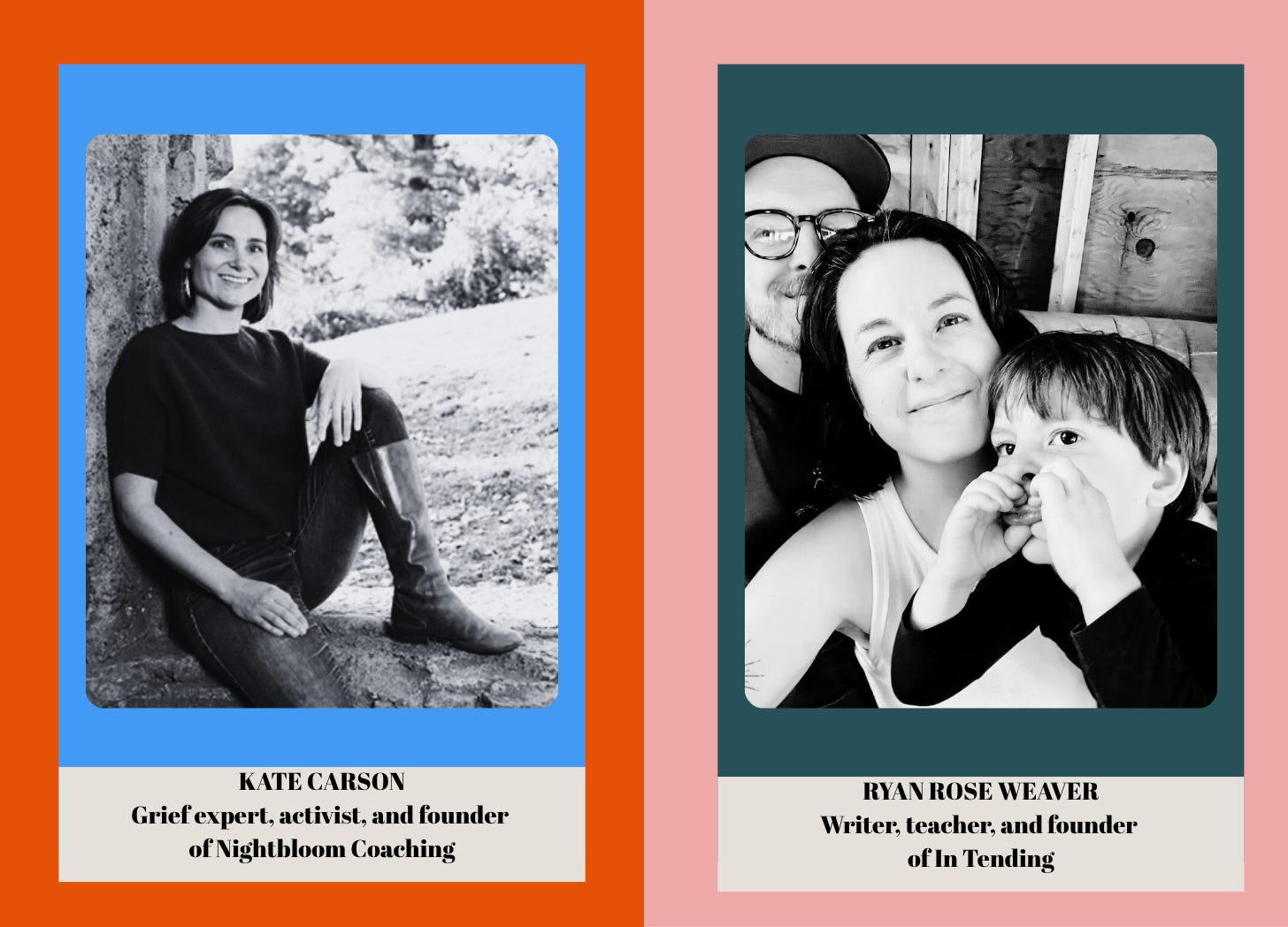
Kate’s story
Ryan: Kate, in my experience, in seasons of grief or trauma, sex has been the last thing on my mind. And right now, we are moving through grief and trauma on a national scale. It seems almost decadent to be talking about getting laid in the midst of all of this. But for you, sexuality has been a powerful path of healing post-loss. Of re-claiming your self-worth and autonomy and power as a woman. This is also clearly needed now.
Can you help us understand here how this came to be, so that some of us might be able to follow your bread crumb trail here?
Kate: This is so close to my heart. Because sexual healing is a real thing.
When my baby, Laurel, was found to be sick, it felt like this was my fault—my body’s fault. Then, when I chose to let her go, to find somewhere legal and safe to release her spirit and then her body from my body, it felt like my body was a tomb in which her body rested, dead, for three days. After, it felt like my body was the scene of the crime. My body continued to look pregnant for many weeks, and people would comment on it, and ask about it, and I would have to tell them that she was already dead.
It was so, so awful.
My husband and I, who had been so together in crisis, felt like we were on different planets in grief. He was a high-functioning griever. He went to work. He could stand upright and move throughout his day like a pretty normal person. I was a basket-case griever, collapsing to the floor in my tears, dragging myself out of bed in the morning, wailing like an animal at night. There were even parts of me that rejected healing, little voices whispering in my ear: “If you ever feel good again, you’re forgetting Laurel. Stay in the tortured-place, because that’s where she is.”
Our griefs were diametrically opposed, and it made us both feel so lonely, so misunderstood, and so afraid that we wouldn’t make it through.
When my husband and I would try to talk about our troubles, it just devolved into feeling hurt and lonely and misunderstood. But when we touched, I felt him close. There was nothing left to say. It was the one place we could meet and really feel together. It was a kind of comfort we could give each other that went beyond words.
I still don’t know how to heal a broken heart—but this taught me one way to heal the body. Pleasure is so, so kind to the body. Going through the actions of comfort and pleasure, surrender and ecstasy makes peace with the body in a way that no amount of positive affirmations ever could. To layer pleasure with enormous, painful emotions like sadness is also to wire them together in the body as safe.
In that place, the story of that little voice—the voice that says that I’m forgetting my daughter—feels so obviously incorrect. Sex helped me feel my grief as love. That there’s really no end date or expiration on love. It’s safe to let the sadness rise and fall as it will, because the love is infinite.
I want to be very clear, though, that I’m not rushing anyone to put anything in her vagina after grief or trauma. I see sex as far more expansive than a penis in a vagina. I am encouraging her to feel her physical body, to receive whatever good things are here for her.
That said, all the trauma data shows that we can increase the efficacy of any healing technique by bringing in trusted loved ones, so partnered sexual healing can be particularly potent here. When the triggers are literally in the pelvis, when the memories come flooding, and when there’s just love, and gentleness, pleasurable touch, that does so much for integrating the experience of trauma.
I also share that if and when we do open ourselves to vaginal touch, there can be tears. There can be flashbacks. But I teach a lot about the cry-gasm, too—how healthy and normal it is, what a good sign it is if you have one, and how healing it can be, to be met and approved of by your partner in that intense reaction.
Ryan: Thank you for sharing all of this. This is what so many of us long for, right? To be met and approved of by our partners in a moment of imperfection. This is the kind of experience that pushes back on the authoritarian narrative that you have to look and behave a certain way in order to be worthy of care.
I think when we are rooted in that kind of care, in that kind of unconditional security and acceptance, everyday men and women become very, very powerful indeed. And I can’t think of a situation that would require more radical acceptance than two people coming together after a loss that, as you say, turned your body into “the scene of a crime,” and re-claiming that place for love.
Re-imagining intimacy in midlife
Ryan: Lately, you and I have been talking about what it means to be mothers who arriving in this midlife phase of our lives. One topic that comes up a lot in conversations with people in this phase is energy, or libido. Some people experience a drop. Some people experience a spike. How do you help people continue to tap into this source of energy, even as their bodies change?
Kate: I really think that we need to be able to maintain pleasure and connection through life. But if we try to make it look like a youthful version of sexuality, it’s going to hurt our bodies, and it’s going to be terrible for our souls.
So, for example, a lot of women may be experiencing painful sex in midlife, even if they never have before. So when we talk about sex and aging, we do have to talk about that. Everyone’s so obsessed with their forehead tissue, but I am much more obsessed with my vagina tissue for this reason, personally!
Men can also have huge confronting issues. Erection may become harder. They may experience prostate cancer, and if they have to have interventions on the prostate cancer, that might really screw up libido. Similarly, if a woman has had breast cancer, she will have been effectively chemically castrated by the treatment.
So a big part of re-claiming intimacy at this age and stage is understanding, “I’m gonna have to find a whole ‘nother way.”
My clients all want to find the new way. That’s why they come to me.
On the other hand, to be honest, several of my friends are like, “No, I don’t want to find a new way. I just want to give up.”
Ryan: Wow, that’s so interesting. And it reminds me of a conversation I had with Emily Eley, in which we talked about how hard it is for people to move from the old way of doing business under extractive capitalism to the new way, whatever that might be. We are discovering that “new way” one step at a time, and that uncertainty can elicit different reactions from everyone.
So I wonder where each person reading here might fall on this continuum. Also, what if we’re someone who falls in the middle of the continuum—if we’re feeling like we might just need a minute, i.e. amid grief or trauma, to regroup?
Kate: Taking a break can absolutely be part of this process. There are some women I work with in midlife who absolutely should not be having penetrative sex, for various reasons. Sometimes they get back to a place where they can again, and sometimes they don’t. I’m less interested in that and more interested in what’s here for her, regardless.
My work here may also involve winning over her partner. Which we always do.
Sometimes—and here I'm just generalizing about a heterosexual couple—at first he’s like, “Aw, man, I don’t know. Penetrative sex is so important to me.” But what a lot of men don’t realize is that it’s actually intimacy that’s important to them. And that’s a very vulnerable thing to say. Intimacy you can have no matter what.
Ryan: I love that. And when the focus is intimacy rather than p-in-the-v intercourse, what does that open up for a couple?
For example, I imagine there can be a pivot from “What are you doing with your body?” to “What is this actually feeling like in your body?”
Kate: Yes. And also: “What is it like, between us?”
Ryan: That pivot—from “How is this supposed to look?” to “How do we feel?”—sounds like part of “the new way.” I think for so many of us, we were never taught to think about sexuality like that. It certainly feels more liberatory.
“Let’s have no goals. Let’s have pure curiosity.”
I’m also wondering if there’s a shift in midlife once you decide, as a couple, that you are finished with procreative sex. One or both of you are done making babies with your body. In a way, this decision comes with its own waves of grief. But it also means that sex in midlife doesn’t have to be focused on any particular outcome. There might be more opportunities to take breaks, as we talked about—and there may also be more room for curiosity, around what emerges after that.
Kate: Yes. This can even begin with an experiment where you say, “Let’s take the orgasm out of it. Let’s have no goals. Let’s have pure curiosity.”
And to be clear, I don’t mean to say you always have to take the orgasm out of it. I love orgasms. They’re, like, my favorite thing in the whole world. But paradoxically—there are a lot of paradoxes in this work—my path to having more and better ones has been to take the pressure off of it, to take the end goal off of it, to explore the road of it.
I think that’s why so many of my friends are like, “It’s not worth the effort.” Because it does take time, and it does take practice.
Ryan: Here I wonder too about the question of low libido, or even disassociation from the body. I wonder if for folks who feel this way, it’s like you’re describing baking an elaborate cake—but they don’t feel hungry.
Kate: Yes. And there’s a risk of misinterpreting what I’m saying. Someone might feel like, “You’re trying to feed me cake when I’m not hungry!” When really, I’m like, “But doesn’t it still smell good in the kitchen?” Because there is still joy in there. If you slow down, you’ll find it’s still here for you. And if enough time passes, and you stay here, you may get hungry again.
This is also what we talk about when we talk about responsive desire—meaning, desire that arises within the act of intimacy, not as the precursor to it. It’s not just responding to feelings of desire that are randomly passing though. It’s choosing to engage in attentive time, together.
At the same time, sometimes when her libido is non-existent, and particularly when sex feels dangerous to her because it’s been hurting lately, a lot of guilt can also build up. In that case, one of the most empowering things to do in that case can be to give intimate touch. Not of your vagina—your attention. To give your hands, your touch, your kisses. To give the things that actually feel good to give.
And of course, it’s great if things feel somewhat equitable over time. But it’s more important that each person is fully capable of inhabiting giving, and fully capable of inhabiting receiving.
Ryan: Here we’re assuming that some form of giving does feel good, right? If not, then there’s probably other issues in the partnership that need resolving.
Kate: And part of that is, again, because they’re often all caught up in guilt. Part of it is also habit: “Oh, blowjobs have never been his thing,” or “She doesn’t really get off on oral sex.” But part of it might also be, “Well, I think I’m doing it wrong anyway.”
In this case, practice itself can help. With my clients, I even offer guided practice, which is a little edgy.
Ryan: How does guided intimacy practice work?
Kate: They can turn off their camera, they can turn off their microphone, they can turn off my screen—whatever they can do to feel as far removed from me as possible. I also always have a pre-recorded audio that they can use on their own if they need that level of privacy.
It’s still weird for a lot of people to have someone else’s voice in their bedroom. But often they really want to do it. They just avoid it because it’s been scary for so long.
And I guide it much like a meditation, directing their gaze. The one giving the touch is the one looking. So if she’s giving the touch, she’s looking at her partner. Watching for micro expressions. The partner’s job is just to receive, and not to have an orgasm. We actually avoid it on purpose.
That dynamic completely shifts the way most people are with each other in intimacy in the bedroom. And once it’s completely shifted, a whole world of possibility opens up. Because both positions are extremely empowering, and tender, in a way that nobody expected them to be.
You learn that you can cultivate curiosity about your own body’s erotic potential, sensory feelings, and responsiveness. You can have curiosity about your partner’s body, about your partner’s feelings and senses. Each of those positions is unique and important, and can completely transform your sex life.
Ryan: It is amazing to me how many of our interviews come back to this important theme: Curiosity is the antidote for guilt.
It also sounds like cultivating this kind of open-ended, courageous, non-linear, mutually respectful connection in our personal lives can serve as an important counter-balance for the feelings of helplessness, disconnection and despair we may be feeling in this political season. Which, again, might help refuel us for the resistance ahead.
In any case, I think these insights have implications in spaces far beyond the bedroom.
Speaking of which: where else, besides the bedroom, have you come to find a sense of healing, creativity or freedom in your own body over time?
Kate: Beauty in all forms. I love to create art that comes from nature. Written beauty. Decorated beauty. Photographed beauty. Many years ago, I bought a cheap little macro lens for my phone, and I went around with my nose in the dew drops snapping big pictures of tiny things. I also love climbing trees. Being outside. Intense wind. Swimming in the ocean. I like to be buffeted about a little by nature.
Where can people find you if they want to engage further with your work?
You can find me at www.nightbloomcoaching.com + www.nightbloomcoaching.net (I’m in the process of combining the two)
@Nightbloomcoaching on Instagram
Recently, Kate and I decided we’d like to open up conversations like this to others in this community. So, in the next few weeks, we’ll be hosting the following workshops:
Coming Home to the Body – Weds January 28 (tomorrow!) at 12pm EST (recording available)
This mindfulness and writing workshop is for those who are interested in learning meditation and somatic practices for coming home to the body, and remembering our deep connection to the living world around us. From there, we will also explore ways to divest from hierarchical systems that deem some bodies more worthy of care than others.
Re-Imagining Intimacy – February 25 at 12pm EST (recording available)
One of the ways in which the patriarchy keeps us all on the treadmill, distracted from larger political battles, is by telling us that if we don’t work hard to remain attractive, available and youthful-looking, we will die alone (see: “childless cat ladies”). In this meditation and writing workshop, we’ll explore less coercive, more equitable, and more trauma-informed ways of giving and receiving caring touch, with someone you love or even on your own. When we are rooted firmly in relationships of care, care that we don’t have to earn by having the right kind of body, we become more powerful.
Note: This workshop falls within the same month as Valentine’s Day; you might even invite a loved one to purchase this for you if you’d like to come, and then share the learnings with them.
Reclaiming Our Power – March 25 at 12pm EST (recording available)
Capitalism and patriarchy love to tell us, especially women, that there is an expiration date on our personal power. That our wisdom and talents become irrelevant at midlife simply because our bodies and faces look different. That we need to buy new things for those bodies and faces in order to become “relevant” again. In this workshop, we put our K-12 teacher hats back on to share stories from history that reveal that our communities have always needed our gifts, and they always will. Then we’ll spend some time writing new narratives of power for ourselves.
How to join us for these upcoming workshops
These workshops are a brand-new offering here at In Tending! Here’s a few pricing options we’ll be trying out for this series.
Sign up for each workshop a la carte:
These will be offered on a sliding scale, from $1-25. No one will be turned away for lack of funds. Paid subscribers to the newsletter will also receive a discount code that allows you to bring a friend.
—> Purchase your ticket for Coming Home to the Body here.
—> Purchase your ticket for Re-Imagining Intimacy here.
—> Purchase your ticket for Re-Claiming Our Power here.
—> Upgrade from free to paid to receive your discount code (via separate email).
Sign up for the 3-workshop series:
Don’t want to spring for a subscription today? You can still get a discount on these workshops by booking all three together.
—> Choose the “Reclaiming Our Time” 3-workshop series option at checkout here.
Join the Mentorship program:
This is a new offering for 2026 as well, and one that I’m excited about. This allows me to provide you with a personalized 1:1 support session to kick things off, and to provide you with open access to every single workshop in 2026 after that (including video and recordings if you cannot attend in-person). Plus, you get all the other paid subscriber benefits—everything from creative prompts and playlists to interview sneak peeks and curated reading lists.
From now until the end of January, I’ll be letting you name your own price (from $75-275) for your annual Mentorship program subscription, making this the best offer of the three.
Save the date!
For those opting to join the Mentorship program in 2026, you’ll be getting a huge amount of value out of it in the coming months, as we’ve got a great slate of other workshops planned. (Other folks can still sign up for each one a la carte.) Registration info and paid subscriber discount codes coming soon, but for now, please save the dates for the following:
Thursday, March 26 at 12pm EST: Rituals and Writing for Grief, with Emily Marlowe
Wednesday, April 8 at 12pm EST: Tending Your Spiritual Truth, with Sarah Kokernot
Wednesday, May 6 at 12pm EST: Marking Complicated Mothers Day, with Lisa Sibbett
Thursday, June 4 at 12pm EST: Where Mindfulness Meets Internal Family Systems, with Jeremy Mohler