

I love so much to work with what the world doesn’t want to see, doesn’t want to talk about. I love so much to delve deep into that and say: you’re not alone. I’m here.
— Kate Carson, grief mentor and activist
When I entered the bardo of post-babyloss grief three years ago, many people asked me if I had already encountered the work of Kate Carson.
Have you met her?
Have you read her stuff?
She’s like, the expert at this.
And also the nicest person ever.
Kate, as it turns out, lost her own beloved daughter, Laurel, in her 35th week of pregnancy, several years ago. She has gone on to mentor thousands of loss parents through her Facebook community, as well as her private coaching practice, Nightbloom Coaching.
This makes us colleagues, as I now work with perinatal loss survivors myself, and we both engage in storytelling-as-activism in collaboration with organizations like Free & Just.
Here’s the real kicker, though: Kate is now also my new neighbor. She lives just a few minutes away from me in Central MA.
Sometimes, the synchronicities that arise in this world of what Kate calls “purpose-work” truly astonish me in this way.
Kate and I connected recently for this interview so that I could hear firsthand from her about what grief has taught her, both about the nature of life as well as about how to help other people keep living when someone they love has died. I had a feeling that her wisdom might serve all of us who are missing someone we love, as the holidays approach.
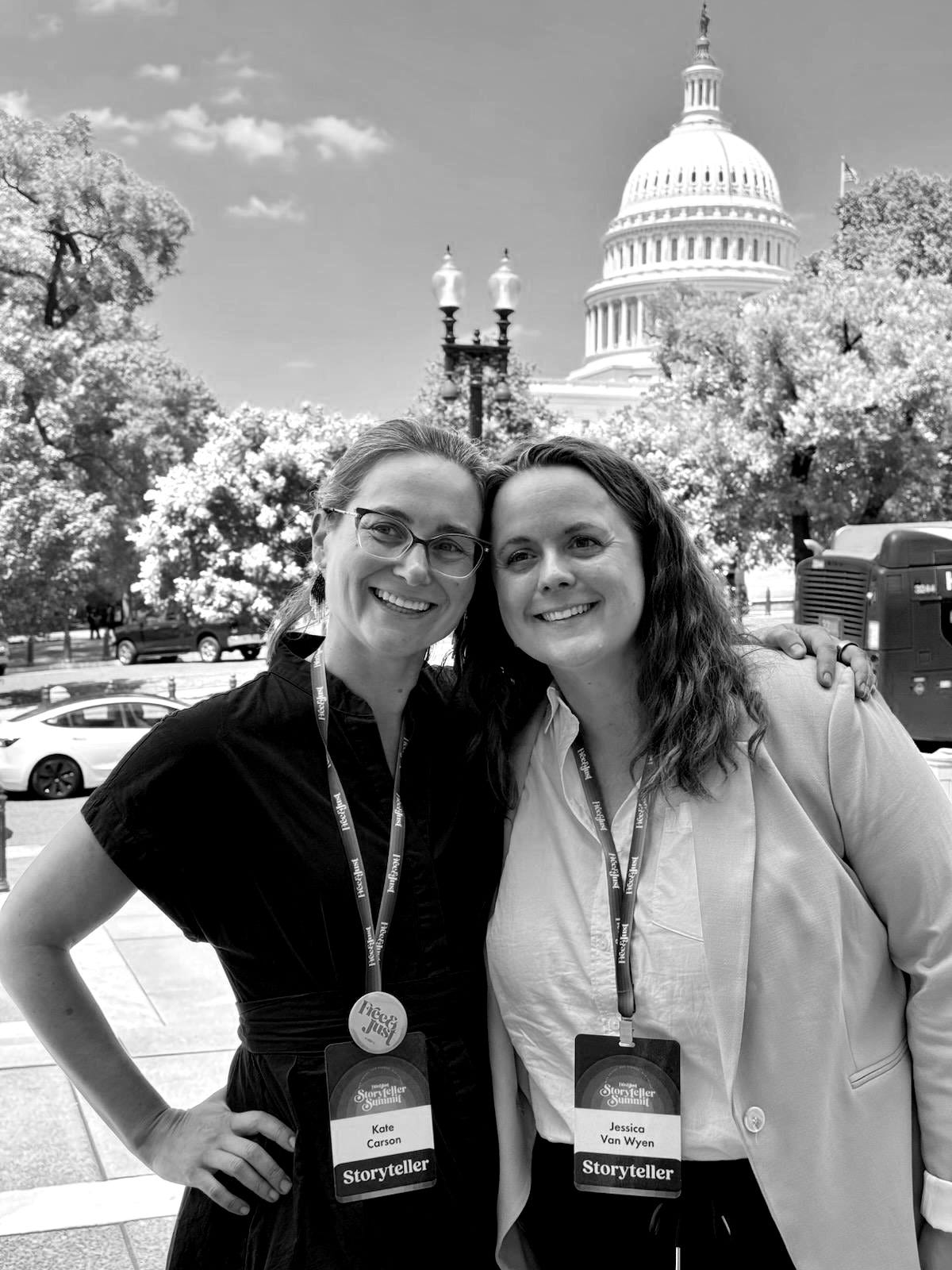
In this interview, Kate offers her own hard-won personal framework for working with loss and healing. Rather than sorting feelings and experiences into the good old Five Stages of Grief, she thinks of grief and healing in ways that make me think of the rings of bark on a tree.
At first, she says, you’re in “total nervous system meltdown.” Then, you enter the place where people think you’re doing better—but you know that you’re still doing pretty bad. Then, one day, she says, you realize, “I’ve grown big enough to hold this terrible thing.”
As we spoke, I realized that this trajectory feels true for me, too. I lost my daughter-to-be in 2022, three years ago. I spent about a year in meltdown mode. I started writing again in 2023, which helped me to heal primarily because I heard from others that it helped them too. I re-named my newsletter In Tending in 2024, shifting its focus away from my own storytelling-as-advocacy to a focus on advocating for the wellbeing of all caregivers. Now, three years on, I’m working with a remarkable, compassionate business coach to create a sustainable long-term structure around this enterprise. My healing work has become my purpose-work.
I think there are many others like us out there. If you are reading, you may be such a person, or you dream of one day becoming one. The kind of person who has been through the storms of change, illness and death, and knows that these things cannot be avoided, just weathered. The kind of person who has taken the torn-up boards of their broken life, and used them to build a lighthouse for someone else.
For me, and for so many others who have been lost at sea, Kate is a lighthouse. May the glimmers of healing she offers here help to guide you home.
Before we jump into Kate’s interview, some housekeeping notes:
If you live in Central MA, please come meditate in person with me on Sunday evenings at 7pm in November! Click here for more info and to register.
Be sure to mark your calendars for our next donation-based caregiver circle on Tuesday, December 2nd at 10:30am EST on Zoom. We’ll be discussing burnout prevention. To learn more about what goes down during our circles, click here. To get on the list to receive our Zoom invites, please click here.
Please save the date for our first gathering of 2026: a conversation and workshop with Kate Carson on Coming Home to the Body in Midlife on Thursday, January 29th at 12pm EST. We’re so excited to talk more about a topic that feels relevant to us and to so many other people we know, especially at a time of year when we are inundated with more negative, critical messaging about our bodies. (More details to come in future newsletter posts, so stay tuned and subscribe if you haven’t already!)
Okay, back to today’s conversation!
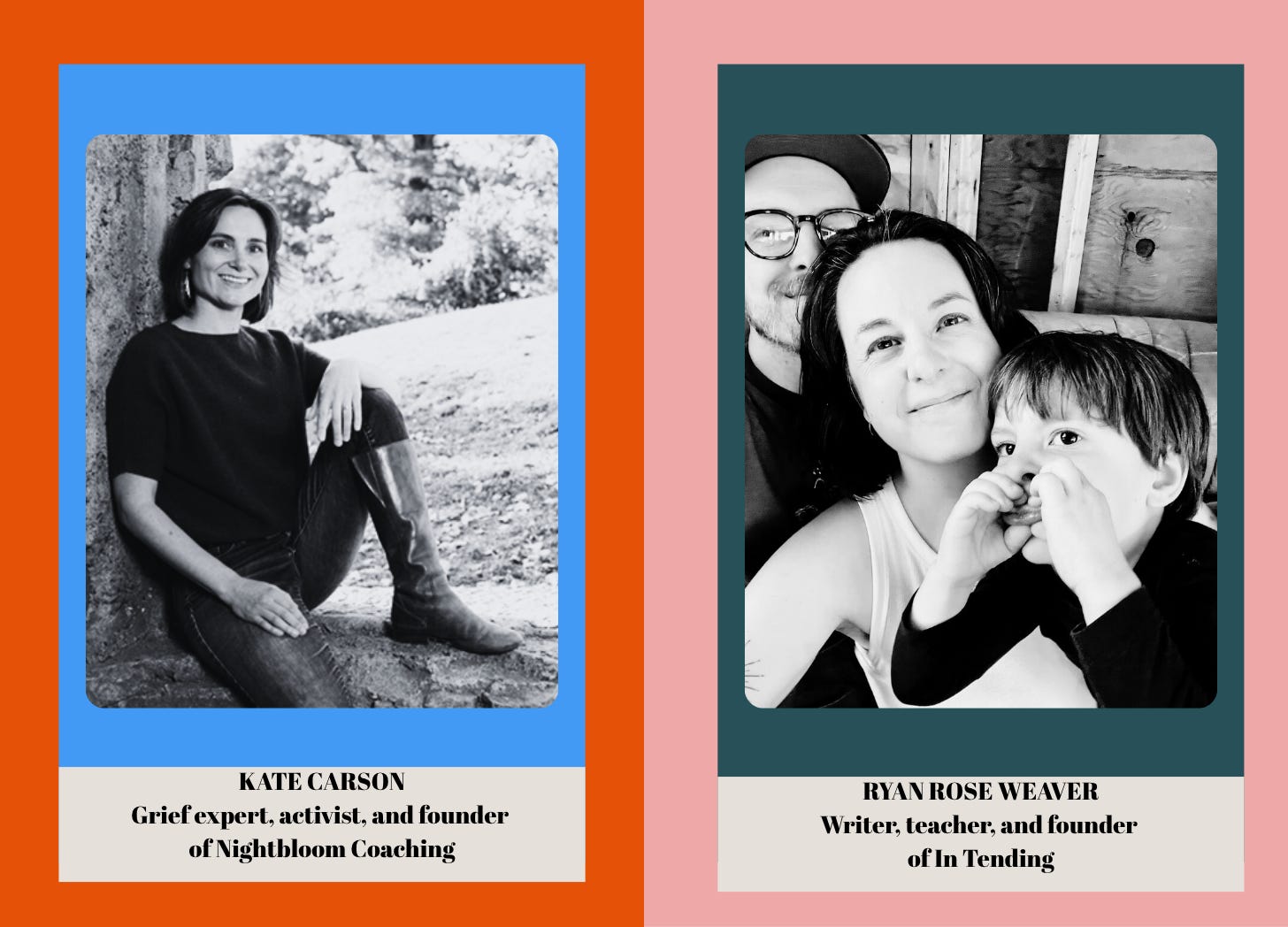
Ryan: Where did you grow up? What else grows there? What was it like for you to grow there?
Kate: I grew up in suburban/semi-rural Massachusetts. I had an objectively excellent childhood. I had the freedom to traipse around in the woods and in the fields after school every day, climbing trees and catching frogs. Excellent public education with teachers who inspired me and cared about me. A stable, supportive family who met my material and emotional needs. I won the lottery being born how and when and where and to whom I was.
That said, I still found plenty to complain about. I felt socially stifled in a place where every single person remembers every thing that has happened to everybody since grade school. I thought people who returned to their hometown to live were nuts. I went away to college and really enjoyed the fresh start of meeting a whole new range of people.
Now, 20 years after graduating, I’m living in a town just like the one I grew up in, and my daughters have the same critiques of semi-rural Massachusetts life that I had. I can only hope they see their childhoods as objectively excellent, too, by the time they’re 42.
Ryan: What is your earliest memory of tending another being?
Kate: The first memory I have of anything that could be called tending is a kind of death-work. I think I was in middle school. My beloved cat Milo was hit by a car. I ran out to find him dead, but still warm.
Milo had been a deeply faithful cat. He’d trot at my heels when I went out to the fields and forest to play. He’d accompany me to the edge of his territory, then stand guard meowing until I came back. I always made sure to come back the same way I left so that he wouldn’t stay out all night worrying. He had a gap in his lip through which he would drool while he purred. I had to put a towel down every time he dug in for snuggles. I was devastated that he died.
That day, I picked him up. He looked perfect, but was very limp. I brought him inside, and my parents got a box for him. I curled him up in the box.
Soon after, I was walking on a farm where there were miniature pumpkins growing. In the moment, I felt moved to pick a little pumpkin to bring it back to Milo’s grave. I picked out the prettiest one, put it in my pocket, and kept walking.
That day, the farmer was in the field. He came blazing over, telling me that I was a thief. I was absolutely mortified. I didn’t fess up to the pumpkin in my pocket, even though we both knew. But I left it in the woods, because I didn’t want to bring home stolen goods either. This thwarted tending impulse was cemented in my brain forever by shame.
Ryan: What or whom have you most loved tending since?
Kate: When I was a teenager and young adult, I loved working with kids. I was a swim teacher, a diving coach, a babysitter, and camp counselor. I also did some environmental volunteering, and spent a lot of time up a tree with one friend in particular, imagining the spirits in everything.
These days, I tend an awful lot, to the point of exhaustion sometimes. I have my own living children, the memory of my deceased daughter, my husband, my home, our elderly cat, 10 chickens, and 3,000 grieving parents.
Grief work still speaks to me the most, perhaps because it’s so under-served by the world at large. Where I lack, someone will step in in the joyful, proud, fun moments of caring for kids and pets. But for the bereaved, not everyone has it in them to show up and tend, to get right up close to the rawest grief and sit down to listen.
Ryan: In your practice with Nightbloom Coaching now, what kinds of grief do people ask you to tend with them?
Kate: All manner of taboo and tender problems: aging, disease, sexual dysfunction, hurting or failing relationships. I love so much to work with what the world doesn’t want to see, doesn’t want to talk about. I love so much to delve deep into that and say: you’re not alone. I’m here.
“It was like she was falling down the stairs over and over, all of the time, without ever stopping”
Ryan: As you touched on above, you and I both lost daughters-to-be in late pregnancy. I imagine this is one reason why you and I both feel called to talk about the kinds of grief that feel stigmatized or taboo.
What, if anything, would you like to share about your own path to family-building, and what it taught you about grief?
Kate: I can honestly talk for hours about my reproductive journey, but I’ll try to be brief.
My husband and I married young, at 22 and 23, and we wanted a big family, with four kids. It started well, with my first pregnancy being one of those textbook pregnancies: queasy at first, blooming into glowing lovely later stages. Our first daughter was born in 2009, when I was studying towards a PhD in metabolic engineering. Elsie was an easy baby. All my problems were normal, common, mundane problems.
Then, I had three miscarriages in the years after I had Elsie. One needed help in the form of a D&C, when the miscarriage just wouldn’t complete on its own. Two were spontaneous. Each was increasingly scary, because I didn’t know if I’d ever be able to have another child again, and I deeply wanted to have more kids.
When I finally got a “sticky” pregnancy, it was fraught with the anxiety of the previous losses. I got labeled as an “anxious patient,” and I think that ended up being part of the problems that arose. All testing came back healthy until our anatomy scan, when a red flag was raised, but upon a Level 2 ultrasound, the concern was dismissed. I was told to enjoy my pregnancy, and that I didn’t need to come in for further testing.
But it kept eating at me. What if the problems were actually there? I just couldn’t shake it. I had tangible concerns to point to as well. This pregnancy was very different from my healthy glowing pregnancy before. I was sick through 25 weeks. And the movements of my baby were so strange. They were constant. No rest. No sleep. And spastic. One of my friends described it in this way: “It was like she was falling down the stairs over and over, all of the time, without ever stopping.”
My midwife didn’t like how worried I was, so she scheduled me for a “peace of mind” ultrasound, which was rescheduled again and again because the hospital had to make room for emergencies. By the time they brought me in, I was 35 weeks pregnant.
They found that my baby’s brain had not developed properly. She had two different sets of brain anomalies: Dandy Walker Malformation, and Agenesis of the Corpus Collosum. The latter is a seizure disorder, and probably explains the weird and constant movement. My baby was not ever expected to walk, talk, support the weight of her own head, or swallow.
“Then what can she do?” I asked the neurologist. “Does a baby like mine just sleep all day?”
He winced. “Babies like your baby are not often comfortable enough to sleep.”
She would die in a dozen different ways, all of them because of her disorders. She would die. And yet, they would not call this diagnosis fatal. And because they would not call it fatal, I was offered neither palliative care for my baby, who would never swallow, nor abortion care to prevent her suffering. I had to travel from Boston to Colorado to access the abortion care that I needed to give my baby peace.
I was in my 36th week of pregnancy for the 4-day outpatient procedure. It was absolutely devastating, but it was humane. It was gentle. It was kind. I was able to induce a stillbirth through euthanizing injection, and then very gradual dilation and induction of labor.
I came home to my 30th birthday with an empty womb and empty arms and the enormous weight of taboo on my shoulders. The hardest thing I hope I ever have to experience.
The grief integration for this took me many years. I fortunately went on to have one otherwise healthy pregnancy, and my youngest daughter is now 11 years old. But this is not a happy ending. The story of the baby who came before her will always be a sad story.
My life is full of all sorts of stories now. The work of integration is the work of making myself big enough to hold them all.
“The more mortals we get showing up to help as they can, the better”
Ryan: What kind of compassion did you feel you needed as a loss parent and did not necessarily get?
Kate: Oof. I needed grace.
I was so lonely. I needed connection. And I got more than just about anyone I know. My friends, my family, my family-friends—they’re fantastic. Appropriate. Sensitive. Brave. And still, it’s lonesome.
I needed different things on different days, so I needed my friends to be able to roll with the punches and take me as I was each and every day. I needed to be able to talk about my baby sometimes, and at other times, I needed distractions from my tragedy. I needed everyone to be brave enough to be near me when I was sad and weird and awkward, and brave enough to look at me without pity, even as many people’s worst nightmare was playing out right in front of them.
I also needed so much cultural support and reassurance. I needed to know that my community wasn’t going to expose me to danger because of my abortion. That they’d protect me, both with their votes and with their social interactions.
I’m lucky that I got a lot of this, but the needs of any grieving mother are so much greater than mere mortals can meet. So the more mortals we get showing up to help as they can, the better.
Ryan: Were there any sources of love and compassion you received in your grief that surprised you?
Kate: Many. So many. Especially my neighbors.
I lived, at the time, in a very Catholic neighborhood, which is typical for Boston. Everybody knows that the Church itself has been a nightmare for women who have abortions. And even though I had not spoken a word of the abortion to them, everyone had seen the taxi pull up. Everyone had heard me wailing. They all knew. But don’t you know that nearly every single neighbor I had showed up to protect me and support me as they could?
The older Irish Catholic woman at the top of the street, with a zillion stories about all the infamous Boston stuff—The Winter Hill Gang, the priest abuse scandal—told me about her stillbirth. The fireman and his wife across the street also said such specific and understanding words. The Italian neighbors next door made me food. The gay guys on the other side of us told off some proselytizer who tried to knock on the door while a friend visited me in the depths of grief. The Buddhist lesbians in the back chanted for me, and still, to this day, send me encouragement when they see my activism. And the Jewish neighbor with the adult son with brain anomalies—she was so kind to me. So, so kind. She treated me like her peer, another mother of a disabled child. I held her hand and brought her food when her own son died ten years later.
I didn’t expect a super Catholic neighborhood of mostly old-timers to show up for me, but the loyalty and protection of this Boston culture is just amazing.
Ryan: How has your experience of grief and healing from your loss unfolded over time, from acute loss to where you are now?
Kate: I can’t even remember the early days clearly. It’s all lost in the fog of grief. I recognize it in the stories of other women in my support group. The go-through-the-motions. The feed-the-body-if-you-can. The absolute devastation of having to realize, all over again, from nothing, that your baby is dead and gone. My darkest days were about 8-12 weeks in, when the numbness wore off. There was so much more to feel.
Unfortunately, I had a therapist at the time who didn’t know grief. Not really. Not the life shattering, out-of-order, heavy-responsibility grief of this particular loss. And, I was a recent engineering grad. Not yet a feelings professional myself. I didn’t know about grief either.
But grief itself is a powerful teacher. Grief taught me parts-work by blowing my ego into distinct and separate characters. Grief taught me surrender by giving me more than I could handle. Grief taught me bravery by turning up my terror with absolutely no way to escape. Grief taught me compassion by opening my heart. Grief showed me how much I can love, for grief is, itself, love.
“The antidote to taboo is connection”
Kate: Now, I talk about grief in three phases:
First, there’s early stage grief, when the nervous system is just in total meltdown all of the time. For me, this lasted about a year. I was visibly a wreck.
Then, there’s middle stage grief. This is when people start to think I’m doing better because I’m more often regulated than I used to be. But the load is still so, so heavy, still all-consuming. For me, this was years two and three.
Finally, there’s later-stage grief, when I’ve grown big enough to hold this terrible thing. At that point, it’s up to me if I want to make my own meaning of it through purpose-work. I do, and that has been my focus, ever since that third year.
Today, life is mundane, and I celebrate that. I love and cherish my boring life. What an absolute blessing to be boring.
And, I work and I fight and I build purpose out of the senseless. Helping people is my grief work now.
Ryan: What did it look like for you to move from tending your own grief to helping others to tend theirs—to shift your career in the direction of what you call “purpose-work”? And what helps you sustain this work now, when it gets hard?
Kate: I talk a lot about the gifts of loss. And by that, I don’t mean to force sunshine into the dark places. Rather, this horrible thing happened, and I would never have chosen it, but it does have gifts, and by God I am going to accept and fully embrace every single one of them that comes my way. I’ve earned it. Purpose is my greatest gift from losing Laurel.
I do so much that is purpose-work now. A lot of activism, a lot of it for reproductive freedom. But the very root of my purpose is this: I want to break down taboo. The antidote to taboo is connection. I support other loss parents because it is the most powerful way I can support my purpose. Healing them heals me and heals the world at large.
Ryan: How can people who are not loss parents, but who want to support the loss parents in their lives, be supportive of their healing journeys on a person-to-person level?
Kate: It is impossible to give a universal “do this” list, as grief is fickle and changing and presents differently from person to person, day to day. But nobody expects you to fix a dead baby. It’s still better to show up and try than to do nothing at all. I would say that sending a card is about the safest thing to do. The griever can open it when she’s ready. Can save it as evidence that she is remembered. That she’s held in community.
I also asked a friend if she would put Laurel’s birthday on her calendar and send me a card the following year. She has sent me a card every year since. For me, this commitment to remembering year after year is incredibly meaningful.
It also helps to ask if they chose a name, and to say the name if they did. People think they shouldn’t “remind” us of our baby’s death, but you can’t remind someone of what was never forgotten. In the thirteen years since my baby died, there’s not been one day when I forgot. Most of the time, when the bereaved stops talking about a loss, it’s not because she’s over it. It’s because she realizes that it makes other people uncomfortable to hear about it.
Recognizing that this is potentially a dad’s loss, too, is really important. Some dads do and some dads don’t experience babyloss as a death in the family. But all dads experience this weird phenomenon where everyone asks “How’s your wife doing?” And nobody asks, “How are you holding up?”
Some other ways to help: ask if there’s any childcare needed. Bring food. Ask if she wants help disseminating information and become a point-person. Ask if she needs help finding or vetting resources, like calling a local infant loss support group to make sure that TFMR moms are welcome there. You can also offer to bring her to a funeral home to pick up ashes, if there are any, or to write letters to the insurance company to contest denials of coverage, which are common in babyloss situations. These are actions that do help. So suggest something practical, and you may get a “yes, please.”
The one thing I would avoid is sharing sentiments like “everything happens for a reason.” Instead, find ways to say, “This hurts so much. I’m so sorry. I love you. I’m here.”
Ryan: We also know the personal is also political when it comes to pregnancy and infant loss. So, how can people support loss parents on a policy level?
Kate: It is so dire right now. The most important thing to understand, if you want to be an advocate for reproductive rights, is that our abortion policy indirectly determines what’s available for all of our maternal healthcare.
Best practice for safe miscarriage often requires the same medications as are used to induce abortion. Procedures like the D&C and D&E are used to stop bleeding in a postpartum hemorrhage. This is one of the most common life-saving interventions that exists in obstetrics. Yet it’s put under political attack all the time because it is also procedural abortion.
So, however you feel about abortion, restricting abortion care restricts best-practice care for all pregnancy and miscarriage care. Your wife, your daughter, your sister will be in greater danger of dying from pregnancy wherever abortion care is restricted.
Another thing to note: Some forms of restriction aren’t as obvious as trying to outlaw important medicines and procedures. Some of it’s downright sneaky. For example, going after how remains are disposed of in the case of a pregnancy loss. “You shouldn’t flush a baby down a toilet” sounds like common sense, until you start talking to your friends and realize how common miscarriage is, how hard it is to tell whether you’re passing a fetus or a blood clot, and the absolute state of shock that you’re in, if you’re standing over the toilet when your miscarriage labor has finally completed. Many, many of us flush. So these laws like these fetal remains laws make it a legal liability just to be a woman of reproductive age.
Now, we’re seeing women get arrested for how they navigate their miscarriages in a state of shock. We’re seeing women allowed to develop life-threatening infections because doctors are hesitant to use the best-practice medicine. We’re seeing women die who could so easily have been saved, as their doctors sit around twisting their pearls and saying, “Oh I’m so sorry, we just can’t.”
They could. In abortion-restrictive states, they don’t.
In my case, I often hear, “But there are exceptions for cases like yours!” Meaning that even if well-meaning people may think, “well there has to be a limit” on gestational age at the time of the procedure, you also have my case, where these brain anomalies weren’t even picked up until 35 weeks. The problem is that “exceptions” do not get applied.
“Rape and incest” is another meaningless exception, because you’d have to prove it in a court of law first, and abortion is needed in a timely fashion. We all know that convicting rapists almost never happens, and in the case of incest, we’re probably talking about a minor whose legal guardian is her perpetrator. How is she going to make it through the courts?
Beware also of using words like “lethal” for fetal anomalies, or “life-threatening” for maternal pregnancy emergency. My daughter’s condition would have killed her a dozen different ways. There was a 97% chance that this would occur within a few days of birth, and almost certainly by the age of 3. But my doctor impressed upon me that this does not count as “lethal.” And I’ve supported women whose doctors waited a week for their organs to fail before they’d consider their emergency life-threatening, even though every single person in that situation knew that was the direction it was heading.
These words do not get applied the way you think they will. It is dangerous to let politicians make a popularity contest out of maternal healthcare. These issues are so nuanced and so heavy that the only appropriate place to rest them is in the hands of the family.
Ryan: I could not agree more. And I also know, given our shared experiences, that having to explain to people why you should be alive is existentially exhausting work.
So, how do you come home to yourself after a hard day of tending? Meaning: How do you tend to your physical body, and your interior life?
Kate: LOL. Not well enough. It’s such a temptation to just pretend I’m immune to the pressures of tending and above having needs myself. I have all the tools, and yet, do I use them for myself?
Ryan: I think many people reading this can likely relate to what you’re saying.
Kate: Right now, today, here’s what I’m doing: I keep an early bedtime, and I keep it sacred. Am I addicted to the internet just like everybody else? Yes. But my screens are off one hour before bedtime. I have special evening lighting: low, pink, amber. A lot of evenings I take a bath with magnesium salts, or use a massage ball to get at my vagus nerve. I supplement with progesterone—which is not for everyone, but great for me.
Then, in the morning, I always walk my daughter to the bus stop, even though she’s plenty old enough to walk herself. In the days of work-from-home, it can be extra effort to put ourselves in fresh air and natural light. So I go with her daily.
There have been times of my life where I did more, when I kept my sexual energy practice active or did sitting meditation. There have been times when I went to yoga several times a week. Today isn’t that time, so I stick to my basic nervous system triage practices, and know that the big guns of self-care are there for me when I’m ready.
Ryan: What communities or sanghas keep you sane?
Kate: For grief, I’d say the community I help hold, Ending A Wanted Pregnancy online. For activism, the group I host, Activist Posse, and all manner of events hosted by Free & Just, and the many incredible women’s rights and abortion rights orgs I work with.
For life, my friends and my family. Everyone needs friends who listen, friends who distract, friends who reveal truth, friends who direct to solutions, friends who take a shitstorm and make it funny. I am blessed with all.
Where can people find you if they want to engage further with your work?
You can find me at www.nightbloomcoaching.com + www.nightbloomcoaching.net (I’m in the process of combining the two)
@Nightbloomcoaching on Instagram
Thank you for the restack, Lori! <3
“The antidote to taboo is connection.” Well doesn’t this just some up so much so efficiently? Thank you for this interview. I’m so happy to see two such incredible women connect and share their wisdoms and talents!