
Re-defining ambition, with Clare Egan of Life After Trauma
On healing ourselves and helping our communities vs. simply making money


When the bottom fell out of my life, I had to figure out a way to keep going. I decided to take all the ambition I’d poured into my career and instead invest it in rebuilding my life. It took many years of hard work, therapy and lots of trial and error, but I am so proud of the life I’ve remade for myself. My work today is motivated by the desire to make recovery from trauma a little easier on the next person. — Clare Egan
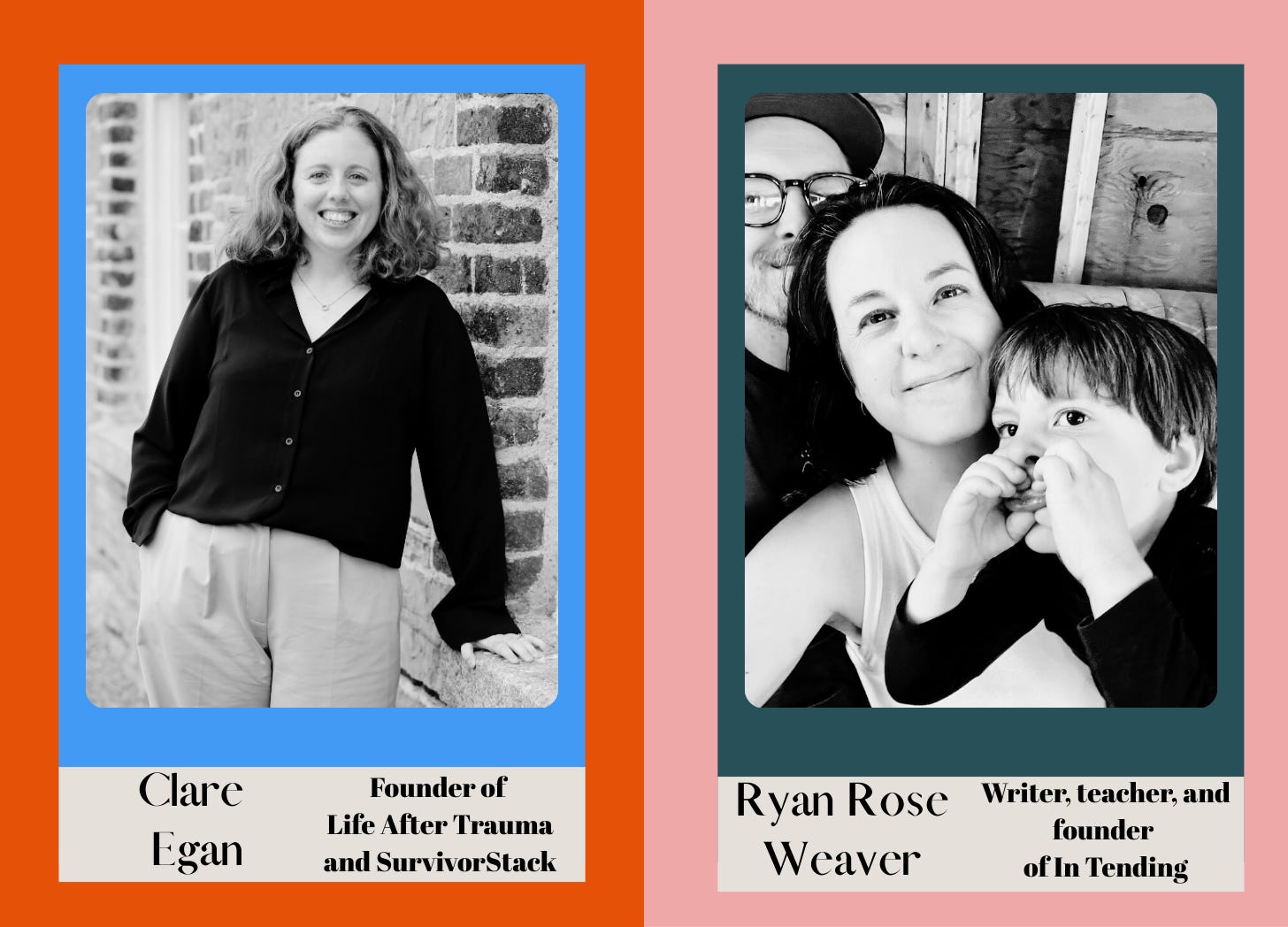
Clare Egan and I live on opposite sides of the Atlantic Ocean, but the contours of her story will be familiar to many readers here at In Tending.
She’s an oldest daughter who grew up caring for siblings.
She places a high premium on time spent with chosen family.
She’s a natural community-builder who goes out of her way to uplift the work of others.
Clare is also a trauma survivor many times over, and the creator of Life after Trauma with Clare Egan. Her work focuses less on the nitty-gritty contours of the traumatic events she and others have experienced, and more on the process of healing from them. Given this, we don’t discuss the details of her experiences with abuse below, but we do discuss the fact of it happening, so we invite you to take care of yourselves as you read.
What Clare and I chose to discuss at length is the importance of revising our approach to ambition, career, and the notion of “entrepreneurship” following experiences of trauma, in ways that honor the fact that there are often more important things, to a survivor, than money and status.
Speaking from our shared lived experience, Clare and I talk about these facets of life after trauma:
How we often need to turn our energies inward for an extended period to care for ourselves after loss, particularly when we lose an important caregiver figure
How sometimes we dream of making something meaningful from our trauma right away, but we also have to be patient with the pace our own recovery along the way
The constellation of projects she’s built to support survivors, including her Artist’s Way gatherings, trauma-informed yoga classes, Monthly Creative Gatherings, and the SurvivorStack newsletter directory
We also talk about what it’s like to pursue fertility treatment in Ireland as one half of a queer couple, and about The Ideas Academy, an accelerator program for early stage social entrepreneurs in Ireland that might serve as a model for other communities who wish to support trauma-informed healing work.
I loved this conversation with Clare, and I hope you will too!
P.S. If the topic of re-thinking ambition calls to you, you may be interested in Re-Claiming Our Power, a meditation and writing workshop I’m cohosting on March 25 with our fellow trauma survivor Kate Carson. If you’re in a place of self-tending following trauma or loss, Clearing Space for Grief, a workshop co-hosted therapist Emily Marlowe on April 1, may also be of interest. These workshops are free for all members of the In Tending Mentorship Program, and sliding-scale pricing is available for all others who wish to attend.
Ryan: Where did you grow up? What else grows there? What was it like for you to grow there?
Clare: I grew up in rural Ireland in the late 1980s. In some ways, it was idyllic. I was surrounded by nature, and had my three younger siblings to play and fight with.
But childhood was a painful chapter for me. I was sexually abused as a young child. And though I didn’t have this language then, I found the omnipresence of the Catholic Church and the misogynistic—or some might say “traditional”—values of that era deeply oppressive. As a young queer kid, it wasn’t easy to try to become myself in that context. I wrote about this time in my life in an essay about coming out for the Huffington Post.
Ryan: I really loved that Huffington Post essay, and I hope folks will take the time to read it after this. You weave together so many strands, from the pain of sexual abuse to the joys of coming out as queer, in ways that are beautiful and healing to read.
Who first tended you?
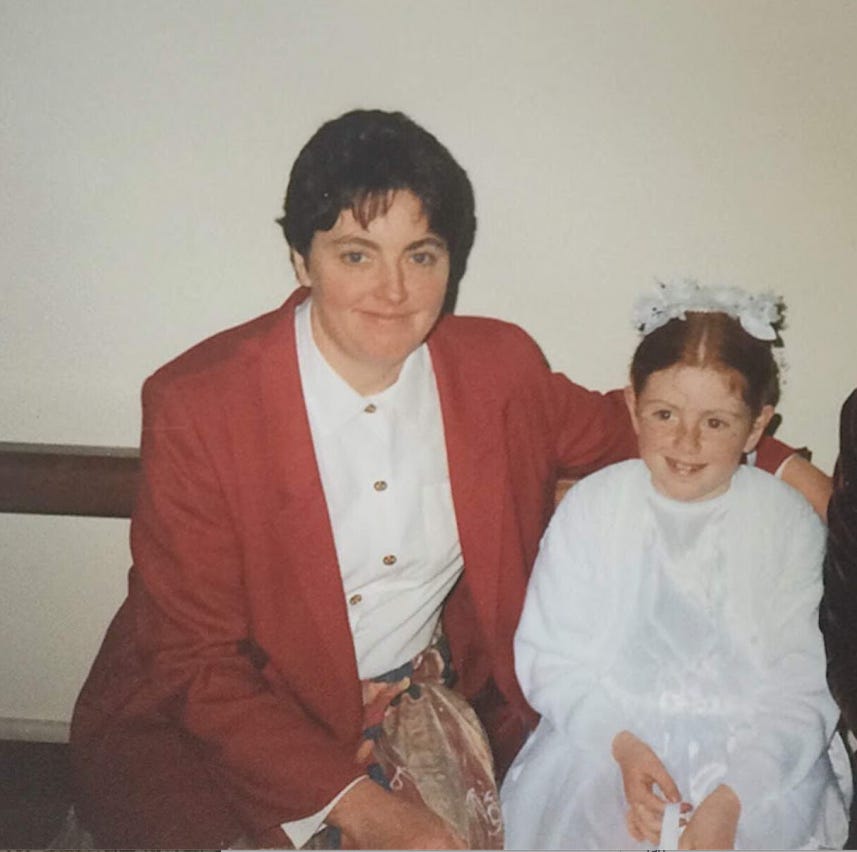
Clare: My mother. She died in a car accident when I was 19, but she was a steady, reassuring presence throughout my childhood. I was her first-born, and we were always very tightly connected. Of course there were moments when we clashed; in a lot of ways, she was very different from me. But there was an unbreakable foundation of love, support and trust between us.
When I got married last summer, I wanted to honour the role she’d played in my life. During our ceremony, I spoke about all the things Mam taught me, how I still feel her presence, and how she showed me what it means to build a happy, meaningful life.
Ryan: What is your earliest memory of tending another being?
Clare: I’m the eldest of four children, so I have strong memories of being part of a happy, rumpunctious brood of young children. There were moments that I hated the noise and chaos of a large family, but there were many other moments when I loved the joyful camaraderie of it.
I did often take care of my siblings—babysitting, and helping with practical tasks. But I also enjoyed being the one who got to do things first and share what I’d figured out with them. Whenever I’m in a big group, I feel that eldest daughter energy bubble to the top and I have to remind myself not to be too bossy—while secretly thinking “Oh, I know a better way to do this!” I’m sure I’m not the only one.
Definitely not the only one–I’m an eldest daughter as well, and feel that same impulse often! Also, I love the word rumpunctious.
What or whom have you most loved tending since?
Clare: This might seem like an odd answer, but I’d have to say myself.
When my mother died, I lost the only person who’d ever really taken care of me. I grieved and raged and cried about that for more than a decade, before I realised that I was going to have to take care of myself, and that I might be worthy of that care.
I’ve been through a lot of other things in my life in addition to that, as I’ve mentioned–sexual violence, workplace trauma. I’m sure there will be many more difficult chapters in my life. But I doubt anything could be as painful as the years when it felt like I had no safe place to land in this world.
When the bottom fell out of my life, I had to figure out a way to keep going. I decided to take all the ambition I’d poured into my career and instead invest it in rebuilding my life. It took many years of hard work, therapy and lots of trial and error, but I am so proud of the life I’ve remade for myself.
My work today is motivated by the desire to make recovery from trauma a little easier on the next person. That’s what keeps me going through the ups and downs of trying to build a new framework for what recovery might look like.
At the moment, I also care for our cat Martino, my community and the people I love. It’s important to me to be the friend who shows up–usually with baked goods!—when someone is going through a hard moment. Chosen family is so important in queer circles and so I devote a lot of time, energy and attention towards nourishing those relationships.
Ryan: You’ve written very movingly about how coming out, and then finding your partner, has been a healing process in and of itself.
How did you meet your partner? What has it been like for you two to make a life in Ireland?
Clare: I first met her at an in person gathering of queer women and non-binary folks who would get together at a local park with drinks, snacks and games on lazy Sunday afternoons during the pandemic. It was a great way to meet new people, and to stave off the isolation that came with living alone and being unemployed during that time.
My wife and I have since built a beautiful life together in Dublin. We have great friends, a beautiful home by the park, and take regular trips back to Rome to spend time with my wife’s parents and extended family.
In general, Ireland is quite queer-friendly, but there are certainly moments when we face homophobia and discrimination. For example, the Irish government provides funding for heterosexual couples who would like to use IVF to have a family. The same funding isn’t available to queer couples. I didn’t think this kind of bare-faced discrimination would be allowed in 2026, but I was wrong. We also recently tried to hire a someone to do some work in our home, but she didn’t want the job when she realised we were a gay couple. These pockets of discrimination can be quite painful to deal with when they do arise.
Ryan: I’m so sorry to hear that this has been your experience, with discrimination generally and with IVF specifically. As a fellow fertility warrior, I have heard so many stories like this, and it’s very upsetting.
That said, gentle congratulations on your pregnancy. [Clare is pregnant now, and due in April.]
Ryan: I’d love to talk more about your other major creative endeavor: Life after Trauma with Clare Egan, your transformative and heartfelt newsletter. How did this project come to be?
Clare: Life after Trauma has been my dream for more than a decade. I’ve always wanted to create a survivor-centred resource that could counter some of the prevailing media narratives about the impact of trauma, particularly sexual violence. I remember sketching out names and logo ideas years ago. It wasn’t the right time for me to start this project then—my own recovery was still too fragile!—but I found the courage to share my story publicly in January 2023, and later that year, I started Life after Trauma.
My goal is to provide stories, resources and community for people finding their way through trauma. I love to host community events, like The Artist’s Way, trauma-informed yoga classes and our Monthly Creative Gatherings.
Ryan: What work-life tensions, if any, have arisen as you’ve moved more deeply into this work?
I think a lot about the emotional sustainability of my work. For example, I used to volunteer with the Rape Crisis Centre here in Dublin. I worked on the phone line taking calls from survivors in crisis, and I accompanied people to the hospital, where they were treated for their injuries. It was deeply fulfilling work, but very emotionally taxing too.
Right now, I’m really happy and proud to be doing meaningful work in a sustainable way. I don’t want to build something useful, only to put my own recovery in jeopardy because I’m passionate about helping others. Burnout serves no one, and I know this work is only sustainable when I’m taking good care of myself.
I’m also still trying to find a way to make this work more financially sustainable as well. I’ve gotten some great support from organisations that support social entrepreneurs here in Ireland, and they’re always asking about how my work can scale. However, I remember telling an advisor that it didn’t work for me to write a business plan for Life After Trauma. I couldn’t be guided only by financial targets or external deadlines. I needed to make my plans, but hold them loosely. I needed to make time to check in with myself through journaling, long walks in nature, in conversations with the people close to me and on my yoga mat.
I’m not selling sausages, or trying to scale a widget-making factory. I’m trying to figure out new ways of thinking and talking about trauma, and how our lives don’t need to be defined by it. The work requires deep personal commitment, presence and a willingness to change and evolve. So I continue to balance my work with a commitment to caring for myself.
Ryan: Your words here resonate deeply. I think many of us are moving through a similar process of re-defining success, in ways that prioritize making a positive, sustainable impact on our communities over time vs. making a bunch of money quickly. You have also used the language of “social entrepreneurship” to frame this approach to work. Can you explain this term for folks who are unfamiliar?
Clare: This is a great question. Many folks haven’t heard about social entrepreneurship so when I talk about it, I often find it easier to describe it as entrepreneurship with a mission. We all have an understanding of what entrepreneurs do, and I think those attributes—skills, mindset, ambition—are what’s needed to create lasting social change. That said, I worry that we minimise the more important, heart-led aspects of this work when we use language that situates it in the world of business. Part of what great social change-makers do is to create a narrative framework for a new version of our world. I don’t think this can be done alone, but I’m deeply curious about how it might evolve through community.
To be clear, I would love to make a sustainable living from this work. It would be deeply meaningful to see it scale and grow beyond my little office. But it’s about so much more than making money and hitting milestones. This work is about supporting our most core selves. It is personal, intimate, sacred work. It’s so much more important than business plans or financial targets.
To put it more personally, I am constantly amazed by how much my life has changed since I began working through my trauma. How much I have changed. The scale of the transformation is astounding to me, and I know many survivors feel similarly. What might this kind of change look like on a societal level? It feels wrong to situate change of this magnitude in the realm of capitalism and commerce. It’s about something much more profound than that.
Ryan: You mentioned above that you have received some additional external support for Life After Trauma, so clearly this rippling-outward effect is already underway. Which entities have been able to provide financial support for this project already? What other funding sources exist where you are?
Clare: The world of funding can be so opaque, so I’m really happy to talk about this.
In 2024 I was awarded a place on The Ideas Academy, an accelerator programme for early stage social entrepreneurs here in Ireland. I completed a 6 month programme of training which culminated in pitching 4 potential investors Dragons Den style.
Thinking about the pitch in advance, I was terrified. Was someone going to challenge my experience of sexual violence? Would they want to know all the horrible details of what happened? Would the panel of investors have the skills to be sensitive to my trauma while also interrogating the validity of my approach? I did a lot of work in advance to prepare my pitch. I practised responding to difficult questions, and role played how I could gently assert my boundaries even if it meant that I damaged my chances of getting funding.
In the end, it was a really positive experience. I was successfully awarded €4,000, out of a maximum potential award of €5,000. I used the money to hire experts to help me to professionalise my work and to host trauma informed yoga classes. The experience was also invaluable in terms of the confidence it gave me, to secure investment from a panel of strangers who felt that my work mattered and was worth supporting.
I am continuing to apply for other grants and funding opportunities, as well as trying to find ways to make my Substack income more sustainable. I want my work to be accessible to everyone who needs it, and always offer complimentary access to those who can’t afford to pay. In order to do that, I ask the folks who find value in the work and can afford to contribute to chip in a few quid each month. This isn’t financially sustainable yet, but I hope it might be someday.
Ryan: One of the things I admire about you is how much you also lift up other people writing about life after trauma–in particular, through the curation of SurvivorStack, a directory of people who are writing on this topic on Substack.
How did this additional project idea come about for you? What has it been like to curate this directory? What have the writers within this directory added to your framework that wasn’t there before?
Clare: Thank you for shouting out SurvivorStack. I’m really proud of this project, which was only possible thanks to the input and suggestions of the wider Life After Trauma community.
Like many aspects of my work, the idea came from my own experience. When I first started trying to recover from the sexual violence I’d experienced in childhood, I really struggled to find accurate information. This was in the 2000s, before #MeToo, before #BelieveSurvivors, before there was any kind of public conversation about trauma and recovery. I read what I could—mostly academic books, and the occasional memoir—but I was desperate for other survivors’ stories. SurvivorStack is the resource I wish I had back then. It’s about honouring our collective voices and finding recovery in community.
There are thousands of writers on this platform, all toiling away in our separate silos. I wanted to find a way to bring us together, so we can read, share and amplify our work. SurvivorStack is currently home to more than 100 newsletters, so to be honest, one of my biggest challenges is keeping up with all the great work that’s being done. I wish there were more hours in the day to read and celebrate all the survivors who are writing about finding recovery after trauma.
Ryan: Are there other writers, teachers or activists beyond the Substack universe that you admire, who are working to support survivors?
Clare: Tarana Burke’s work has been transformational for me. Too many people know of the #MeToo Movement only through how the media has misrepresented it, but if you listen to Tarana’s own voice on these topics, she is deeply inspiring. Her work is laser-focused on survivors and their healing. She talks about the importance of joy, community and finding recovery through action. If you haven’t made the time to watch her talks on YouTube, read her memoir, Unbound, or hear her be interviewed about her work, I really recommend it.
Ryan: How do you come home to yourself after a day of immersing yourself in the world of trauma and survivorship? Do you have contemplative practices, journaling practices, movement practices etc. that ground you?
Clare: Journaling is my starting point, always. I’ve been writing my Morning Pages, which I discovered through The Artist’s Way, for more than a decade. Last year I hosted community exploration of Julia Cameron’s book, which was immensely fulfilling. I’m hoping to do it again! For me, Morning Pages are a powerful way to connect with myself more deeply so I start almost everyday with that.
I also try to prioritise a nice, long walk in nature, ideally with only my wife, a friend or my thoughts for company. I find reading deeply restorative, and I love to get together with friends and experience the world outside my little mental bubble. In the evenings, I am usually completely pooped, so ideally I have dinner with my love and collapse on the couch to watch 20 minutes of a show before I start snoring.
That said, I also love my work. It’s deeply fulfilling, and I feel so lucky that I get to do it.
Ryan: Where can people find you if they want to engage further with your work?
Clare: The best place to connect with me is through my newsletter. I play a little on Instagram and LinkedIn, and also have a website but my newsletter is my homebase.
Your turn: In what ways have you redefined ambition over the course of your career? What would it look like to celebrate the social impact of what you do from the monetary rewards you receive for your labor? What other questions do you have for Clare? We’d love to know!
 | A guest post by
|